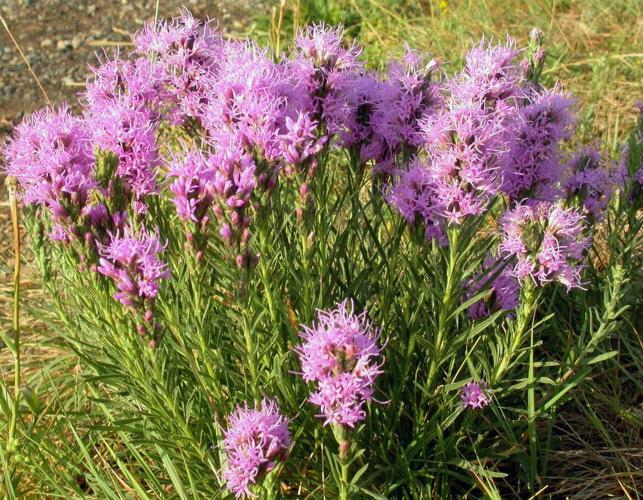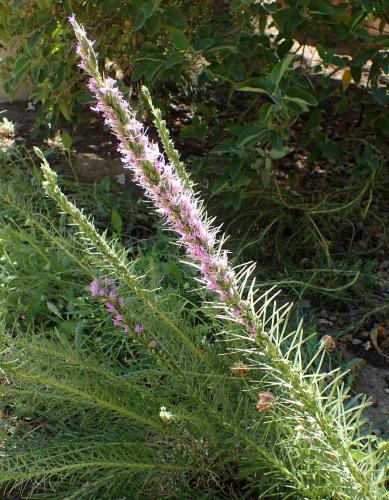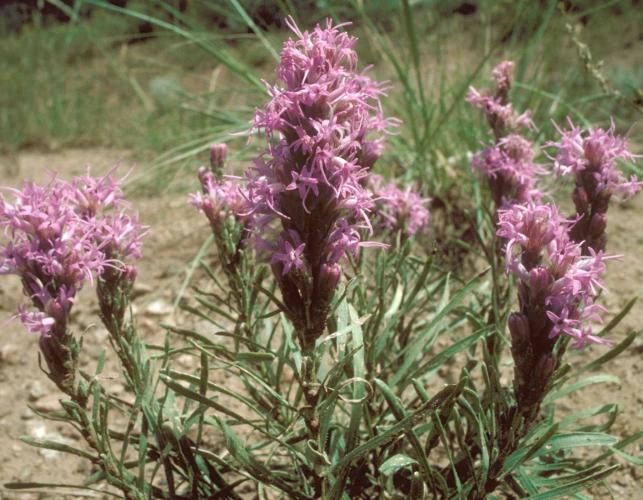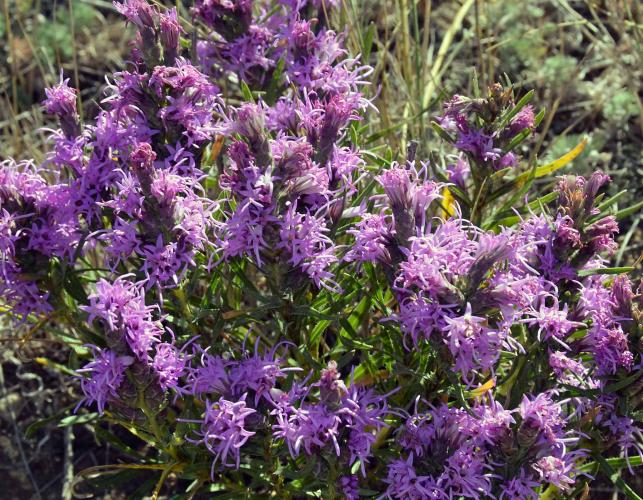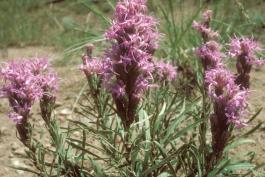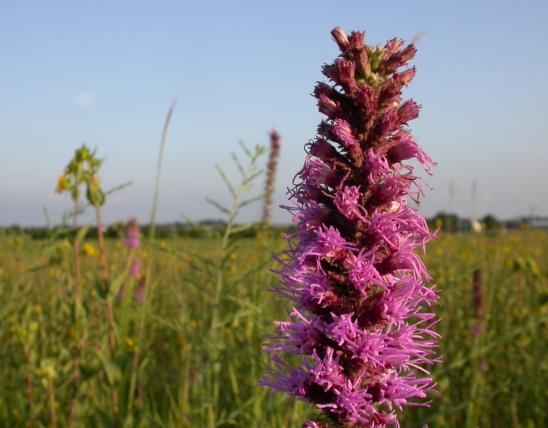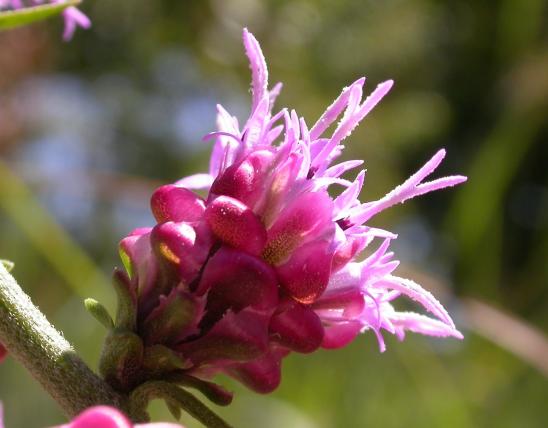








Dotted blazing star and bottlebrush blazing star are bushy and have several unbranching stalks arising from the base. They are very similar, but they live in different corners of the state. In Missouri, their geographic ranges do not overlap.
Of Missouri’s nine species of blazing stars (genus Liatris), dotted blazing star and bottlebrush blazing star are perhaps the most curious. Botanists are still trying to determine how they are related: are they different species, or two varieties of the same species? What if a third species is involved?
For now, here is how we’re presenting them:
- Dotted blazing star (Liatris punctata)
- Bottlebrush blazing star (Liatris mucronata)
We’re treating them here as two different species, but they are sometimes described as two varieties of L. punctata . . . but it’s complicated. See Status for more on their taxonomic journey.
- In Missouri, they live in different corners of the state, and their geographic ranges do not overlap. In our state, this is probably the quickest way to separate the two.
- Because they look so similar, and their botanical status is intertwined, we’re treating them here on a single page.
Here are their similarities:
- Both have a variety of common names.
- They both look rather bushy; they often have several unbranching stalks arising from the rootstock. Both flower at about 1–3 feet tall.
- In both, the magenta-pink flowerheads are densely crowded into an elongated spike at the top portion of the plant stalk; the stalk is usually not visible between the heads.
- In both, the narrow, wide-spreading leaves stick out at right angles and are interspersed along the stalk and floral spike, giving the plant a bottlebrush look.
Despite their similarities, they are also quite distinct.
Dotted blazing star; prairie snakeroot; prairie blazing star
Liatris punctata var. punctata
Uncommon in Missouri’s northwestern border counties (Atchison, Holt, Jackson, Cass, and maybe Bates counties). Occurs in loess hill prairies and rarely upland prairies.
- A bushy-looking plant arising from a single thickened, elongated, carrot-shaped taproot (not a globe-shaped corm).
- Overall, hairless, smooth, except for along the margins of young leaves.
- The leaves are grayish green, rather thick and leathery, mostly straight, with at least some (the younger leaves) hairy along the margins (the hairs break off with age, leaving tiny, stubby bases); glandular-dotted (look for tiny dots on the undersides of the leaves); otherwise mostly hairless and smooth.
- The lowest leaves are the largest, to 3 inches long and less than ¼ inch wide, getting gradually smaller up the stem; with 1 main vein.
- Blooms August–October.
- The flowerheads have only 3–7 florets. White-flowering forms exist but are rare.
- Involucre (receptacle at the base of each flowerhead) 10–14 mm (about ⅜ to ⅝ inch) long (on average, slightly larger than those of L. mucronata).
Bottlebrush blazing star; narrow-leaved gayfeather; Texas blazing star
Liatris mucronata (syn. Liatris punctata var. mucronata)
Uncommon in southwest Missouri, specifically the western portion of the Ozarks (Barry, Stone, Taney, Ozark, Christian, Douglas, Wright, and Texas counties) (the White River watershed and its tributaries). Occurs in glades and ledges and tops of bluffs, on limestone and dolomite substrates.
- A bushy-looking plant arising from a bulblike, globe-shaped rootstock (not a thickened, elongated, carrot-like taproot).
- The stems and leaves are glabrous (hairless, smooth).
- The leaves are green, rather soft, mostly arched or curved outward, and glabrous (smooth; hairless) (not grayish green or with hair on the margins of younger leaves). The leaves are not dotted with tiny glands.
- The lowest leaves are the largest, to 6 inches long but less than ¼ inch wide, getting gradually smaller up the stem; with 1 main vein.
- Blooms July–October.
- The flowerheads have only 3–6 florets.
- Involucre (receptacle at the base of each flowerhead) only 7–12 mm (about ¼ to ½ inch) long (on average, slightly smaller than those of L. punctata).
Similar species: Missouri has nine species of Liatris. For more information about them, see their group page.
Height: Both usually flower at 1–3 feet tall.
Status
Native Missouri perennial wildflowers.
Missouri’s populations of dotted blazing star (L. punctata) (in our northwestern counties) are considered to be variety punctata. Its taxonomic status seems fairly solid.
- Because of its limited distribution and/or small numbers in or state, dotted blazing star is listed as a Missouri species of conservation concern, ranked as vulnerable.
Some botanists consider Liatris mucronata (the one in southwestern Missouri) to be another variety of L. punctata (not a distinct species), and they classify it as L. punctata var. mucronata.
However, the classification of Missouri’s populations of L. mucronata is in transition. The center of distribution for that species is mostly in Texas, and although recent researchers have reclassified it as L. punctata var. mucronata, Missouri’s populations appear to be most closely related to a third species: summer gayfeather (Liatris aestivalis), which occurs in Texas and Oklahoma (not in Missouri). Perhaps Missouri’s populations are a variety of L. aestivalis, or perhaps they are an all-new species. Perhaps these are all varieties of a single species.
It seems premature to guess what our populations of L. mucronata might one day be named. Genetic studies among populations in different regions will eventually sort it out. For now, we’re sticking with L. mucronata.
Human Connections
These and other Missouri blazing star species can be purchased at native plant nurseries and used in gardens. Growing native plants widens the reach of nature, creating more habitat for pollinators and other insects, and the birds and other animals that feed on them.
Punctata means “dotted” and refers to the tiny resin dots on the undersides of the leaves and bracts.
The name mucronata refers to some part of a plant being mucronate: having a tip (usually of a leaf) ending in an abrupt, sharp point (a mucro). In this case it may refer to the abrupt, sharp tips of the involucral bracts.
Naming and describing things, and distinguishing between “this and that,” seems like a fundamental human activity. When it comes to plants, it is a primordial human survival skill. When it comes to the modern world, it is a skill that can help conservationists understand and preserve plants and the environment.
Ecosystem Connections
Blazing stars nourish a variety of insects and other animals and, in turn, their predators. Bushy native plants like these also provide cover for wildlife, and their extensive root systems hold soil, preventing erosion.
Over great periods of time, blazing stars and other prairie and Great Plains plants built up the rich soils of the American heartland.
When the prairies of America’s Great Plains were plowed up, and grassland plants like these no longer bound the soil, a period of severe drought led to the disastrous Dust Bowl of the 1930s.