






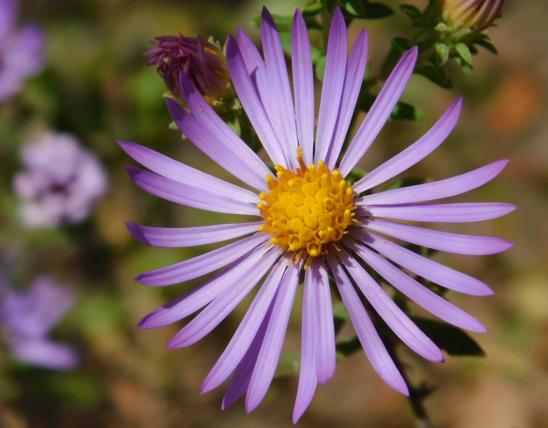


Marais Temps Clair Conservation Area is in north St. Charles County. This 918-acre area was once part of an expansive marsh ranging from St. Charles to Alton.
Media

Status
Name
Endangered
Name
Threatened
Name
Species of Conservation Concern
Scientific Name
Boltonia decurrens
Family
Asteraceae (daisies)
Description
A big river floodplain species, decurrent false aster has declined as muddy bottomlands have been drained and converted to agricultural crop production. It is a federally threatened, and Missouri endangered species.
Decurrent false aster is a perennial plant that grows 1 to 5 feet tall. It may have a single stalk or a cluster of several stalks; it usually has multiple branches. It sometimes grows in clumps. The roots are fibrous; it does not produce rhizomes.
The composite flowerheads are about the size of a quarter and occur in branched groups. Each flowerhead has yellow disk flowers and white, purplish, or pinkish ray flowers.
Blooms August–October.
The leaves are alternate, linear or lance-shaped, narrow, sessile (stalkless), and grayish green. The lower leaves are broader and larger than the ones higher on the stem.
- This plant is called "decurrent" because the leaf tissue extends down the stem from the point of leaf attachment, making the plant stems look winged.
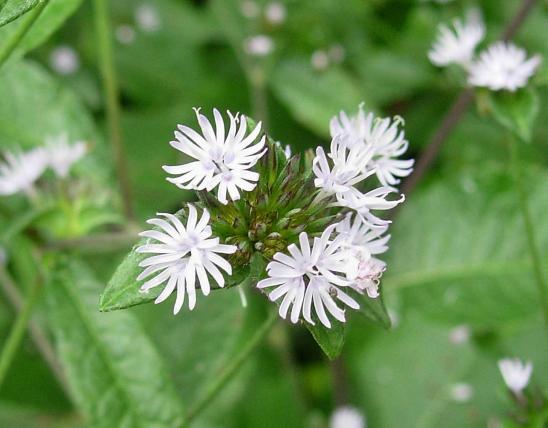
Similar species: Plants in genus Boltonia are usually called "false asters," though many other types of plants also resemble true asters. Missouri has two other species in this genus.
- White doll's daisy, or false starwort (Boltonia asteroides var. recognita), is a much more common, weedy species sometimes used in native plant gardening. It can grow in the same habitats as decurrent false aster; however, it lacks the decurrent leaves, and it has spreading true rhizomes. Scattered statewide, usually in low, moist soils.
- Smallhead doll's daisy (Boltonia diffusa) is uncommon, mostly in our far southeastern Ozark counties and in the Bootheel. It is easily confused with white doll's daisy (B. asteroides), but as the name suggests, the flowerheads are smaller. At bloomtime, the disks of its flowerheads are at most only about ¼ inch wide, while those of white doll's daisy are at least ¼ inch wide (and often up to ½ inch wide).
How to tell false asters (Boltonia) from fleabanes and New World asters
False asters in genus Boltonia resemble fleabanes (genus Erigeron) and some species of New World asters (genus Symphyotrichum).
A key character separating Boltonia from the fleabanes and New World asters is the pappus of the disk florets. The pappus, collectively, is the set of hairs, scales, or awns (slender bristles, usually broadened at the base) atop each of the seeds (achenes). The pappus is most noticeable when the seeds are maturing.
- In Boltonia, the pappus of the disk florets is a short, irregular crown of only 4–10 tiny awns or narrow scales, and usually, at most, only 2 longer awns.
- In Erigeron and Symphyotrichum, the pappus of the disk florets consists of numerous (at least 8, but in some species up to 90) thin, hairlike bristles, sometimes with an outer ring of short bristles or scales.
- Fleabanes usually bloom earlier in the season than false asters.
- In false asters, the floral receptacles (bases of the flowerheads) are much flatter than those of fleabanes and New World asters.
Other Common Names
Winged False Aster
Claspingleaf Doll's Daisy
Size
Height: 1 to 5 feet.
Where To Find

Uncommon along the Mississippi and Missouri rivers from Lincoln to St. Charles counties. Presently it is known to occur only in St. Charles County, with a few introduced populations elsewhere.
Habitat and Conservation
Banks of rivers, margins of ponds and lakes, and bottomland prairies; also margins of crop fields, fallow fields, levees, and roadsides.
Historically, this plant was found in wet prairies, in marshes, and along the shores of some rivers and lakes. It requires periodic disturbance, such as flooding, to reduce competing vegetation and provide the high light levels and moist soil the seeds need for germination and growth.
Conservation methods include wetland protection, low-intensity agriculture, and avoidance of herbicide use.
Status
Decurrent false aster is a species of conservation concern, listed as endangered by the Missouri Department of Conservation and as threatened by the U.S. Fish and Wildlife Service.
- It is declining due to loss of historic river floodplains and wetland habitat, which is caused by the construction of levees and locks and dams along the Illinois and Mississippi rivers, which have prevented flooding in many areas.
- Populations vary considerably from year to year, due to flooding events.
- In addition to Missouri's few populations, it also occurs, to a limited extent, along the Mississippi floodplain in Illinois. It is listed as threatened in Illinois.
Human Connections
Decurrent false aster's decline is tied to human changes to the Mississippi River between Missouri and Illinois. When people halted the natural disruptions of flooding, populations began to disappear.
Americans have tried hard to channelize, manage, and tame the flows of our large rivers. Arresting the natural rhythms of flooding also stopped the processes that created the rich floodplain soil that is so good for farming.
The genus name, Boltonia, honors the English botanist, mycologist, naturalist, and illustrator James Bolton (1735–1799). In the late 1700s, he wrote the first English-language reference to fungi, a multivolume work describing all the fungi that occurred in the area of Halifax (England). Ferns were another special interest of his; he wrote, etched, and illustrated a two-volume reference to British ferns. He researched, wrote, etched, and illustrated all these works himself.
Ecosystem Connections
Decurrent false aster needs periodic flooding or disturbance to eliminate competing vegetation and to provide the high light levels and moist soil that its seeds require to germinate. It responded rather well to the Great Flood of 1993, when its entire global range was flooded for 8–10 weeks.
Occasional flooding is important for maintaining not only this species but also an entire ecosystem of plants and animals that live along big rivers. One reason birds have migrated along what's called the Mississippi Flyway for thousands of years is because of the abundant cover and food (plants and insects) that the habitat provides.
The river channelization and construction of levees and locks and dams that caused the decline of this wildflower also affected fishes and other aquatic organisms. For example, many species of fishes no longer can swim upstream as they used to do and are now restricted to the lower parts of the river.
As with other members of its genus, decurrent false aster offers both nectar and pollen and is visited by a variety of bees, flies, wasps, butterflies, and beetles.
One pollinator, called the Bolton fairy bee, is limited to members of genus Boltonia. It belongs to a group of small bees called fairy and goblin bees (tribe Perditini).
- The Bolton fairy bee specializes in flowers in this genus. The false asters benefit by having their very own pollinator, and the bees benefit by being specially adapted for foraging, collecting, and digesting pollen from these particular plants.
Title
Media Gallery
Image

Caption
A big river floodplain species, decurrent false aster has declined as wetlands have been drained and converted to agricultural crop production. It is endangered and a species of conservation concern in Missouri; nationwide, it is threatened.
Credit
MDC Staff
Right to Use
Photo by MDC Staff, courtesy Missouri Department of Conservation
Image
Title
Similar Species
Similar Species
Media

Media

Media

Media
Media

Where to See Species
About Wildflowers, Grasses and Other Nonwoody Plants in Missouri
A very simple way of thinking about the green world is to divide the vascular plants into two groups: woody and nonwoody (or herbaceous). But this is an artificial division; many plant families include some species that are woody and some that are not. The diversity of nonwoody vascular plants is staggering! Think of all the ferns, grasses, sedges, lilies, peas, sunflowers, nightshades, milkweeds, mustards, mints, and mallows — weeds and wildflowers — and many more!