
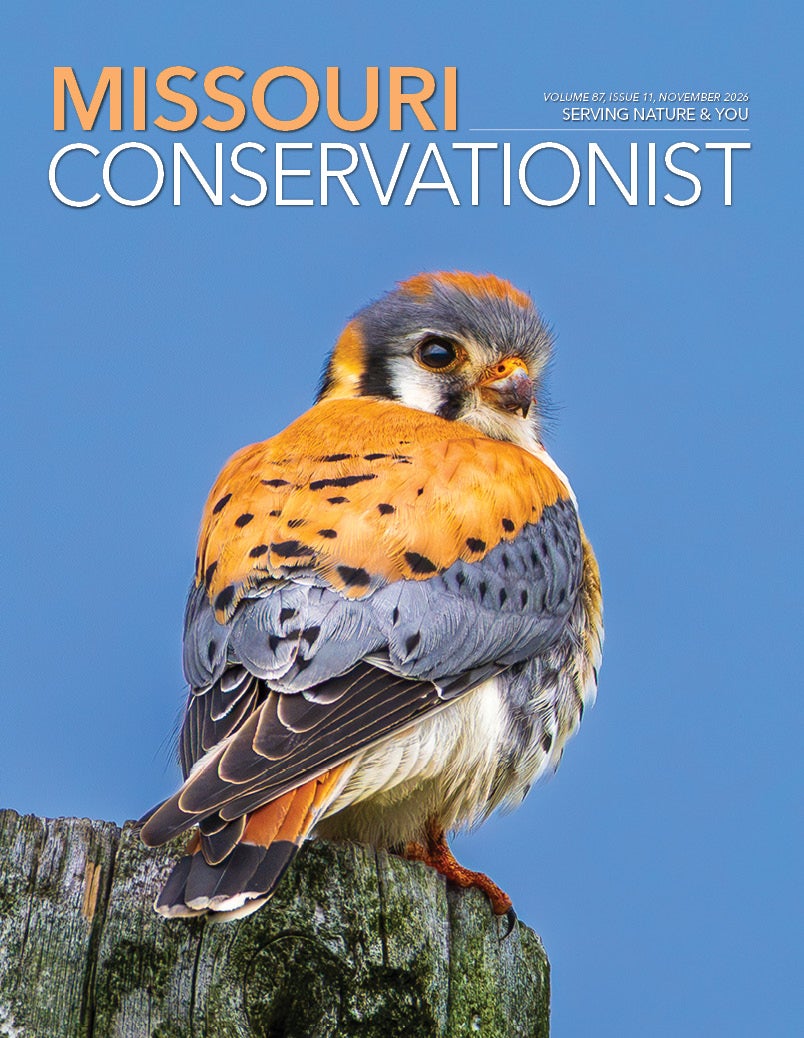

It’s hard not to like kestrels. American kestrels are North America’s smallest falcons and one of our most colorful raptors. Although no bigger than a blue jay, they are formidable hunters, particularly to the small animals that find themselves within the grip of a kestrel’s talons. People who study or work with kestrels often describe them as cute but feisty. When handled, adult kestrels tend to bite and somehow know to set the point of their beak right into the quick of your fingernail. One could sum up a kestrel as a small bird with lots of spunk.
Watch a kestrel as it hunts from a perch, scanning the ground for mice, voles, and grasshoppers. It may be sitting, but it does not remain still. It will bob its head and pump its tail, often repeatedly, as if raring to go. And when it does go, it will be fast, whether dropping to the ground to snatch prey with its feet or crossing a field with the rapid flaps of its pointed wings.
While commonly seen across the continent, American kestrels have been falling in number. Annual Breeding Bird Surveys show that kestrels declined an average of 1.4 percent each year from 1966 to 2019, and the citizen science database eBird shows a 20.3 percent range-wide decline in kestrels from 2012 to 2022. Many studies have sprung up and symposiums held to better understand the plight of these small predators. Scientists are looking at what we know and don’t know about the species and determining what types of questions should guide future research as they tease out what’s behind the decline.
Orphans
Ruth Stephens was well aware of the kestrel population conundrum as she gazed down at two nestling American kestrels who entered her care one day in late May 2025. They stared back at her through big, dark brown eyes. Presumably, the young birds had fallen out of their nest. Found on the ground, along with two siblings who hadn’t survived, they’d been brought to the wildlife rehabilitation hospital at Lakeside Nature Center in Kansas City, where Stephens works as a naturalist.
The two youngsters were barely half grown. Still mostly clad in fluffy white down, their feathers were starting to peek through, showing just enough plumage to reveal the signature colors of their species — thin, horizontal brown and black stripes across their backs and two short, vertical black stripes on each side of their faces. When kestrels’ feathers are completely grown, the wings and tail of a female have the same brown and black striping as the back, while males sport blue-gray wings and a rusty-orange tail with a black band near the bottom. Although the nestlings’ feathers had yet to fill in, enough clues were present to surmise that one nestling was a male and the other female.
With more than two decades of caring for injured and orphaned wildlife, Stephens knew the best thing for kestrels at this age would be to place them back into their nest. But, for these two, their own nest wasn’t an option. So, she’d have to try the next best thing: find another active kestrel nest with parents who might adopt them and raise them with their own offspring.
“If you get young kestrels in the nestling stage, before fledging,” Stephens said, “they’re highly imprintable.”
Imprinting refers to how young animals learn to identify with what they see feeding them. Normally it would be a parent, but if it’s a person, they may “imprint” more strongly on people than their own species. A kestrel imprinted on people won’t interact with other kestrels appropriately and may not learn the necessary behaviors to survive in the wild.
This is a risk with many young animals, but, Stephens explained, kestrels imprint on people much more easily than other raptor species do.
“We have to be really careful to not exacerbate the imprinting,” she said. “We definitely try to limit any contact [with them] and get them to eat [on their own] right away without having to tweeze or feed them like [we might] with some other baby raptors.”
Being raised by another kestrel family would greatly increase the nestlings’ chances of growing up and surviving well. Most kestrels lay four or five eggs each season, but sometimes they’ll lay up to seven. So, parents with an average-sized brood are capable of feeding two more mouths. The trick would be finding a nest with offspring about the same age as the two orphans. To check for possibilities, Stephens reached out to her network of kestrel box monitors.
Nest Boxes
As cavity nesters, kestrels readily use nest boxes. Their most common natural nesting places are holes pounded out by woodpeckers in dead trees. But these cavities are in high demand. Kestrels must compete with other cavity nesters like bluebirds, tree swallows, starlings, and squirrels. And as the landscape has become more developed, tree cavities are harder to find. Lack of them is one reason scientists believe that the kestrel population has been declining over the past several decades. To provide more nesting opportunities for kestrels, people around the country have been putting up nest boxes.
Stephens herself started a kestrel nest box program in 2019, in part to help with the kestrel decline, but also for situations just like this one, because nestling kestrels are brought to Lakeside Nature Center every year. Unfortunately, only one volunteer had kestrels use their box and then that person moved away. After several years with no nesting kestrels, the project faded. Yet Stephens emailed the participants in case 2025 was a lucky year. All the boxes were still vacant. Most of these are in the city, Stephens said, “where we get a lot of kestrels, of course … but it’s a highly populated area with a lot of traffic.”
American kestrels mainly hunt in open fields. When selecting nesting spots, these falcons not only look for cavities, but also grassy habitat with adequate prey. They feed primarily on large insects and small rodents but will also take lizards, amphibians, and small birds. Often perching on a treetop, telephone pole, or telephone wire, they watch and wait, then swoop down to pounce on prey. When perches aren’t available, they hover 12 or more feet above the ground, scanning the grass for rodents and insects. You may have seen one hunting along the highway or above the median, aloft but stationery, facing into the wind and holding its head steady while flapping its wings and flexing its tail to remain in one spot. From above, kestrels can detect ultraviolet light reflected from the urine of voles, which helps them see the trails the rodents make in the grass.
Marlee Malmborg of the Missouri River Bird Observatory (MRBO) started that organization’s American Kestrel Nesting Project in 2023. MRBO already had a monitoring project for grassland species of conservation concern, so adding kestrels made sense.
“No one was really monitoring them in Missouri, so we kind of just saw to build it into our [existing] monitoring project,” Malmborg explained.
While MRBO puts up and monitors its own nest boxes, it also looks to the public to become “kestrel box landlords.” Many participants have open fields on or near their property. The project’s first year, there were 10 boxes with one active nest. In 2025 when Stephens contacted Malmborg, there were 26 boxes on 20 different properties; six had active nests. All the chicks, however, were older than the pair that needed a new family.
Stephens contacted other wildlife centers around the state, but none of her Missouri connections knew of kestrels with nestlings of the right age. Fortunately, someone just across the border in Kansas did. Jim Walton, a member of the Johnson County Extension Master Naturalist program, was monitoring nest boxes on telephone poles not far from Kill Creek Park near Olathe, Kansas — in an area with grassy fields. Two days after arriving at Lakeside Nature Center, the orphans were placed in a new home.
The parents seemed to accept the two extra nestlings, which increased their brood from five to seven. Walton couldn’t check the box regularly but said a neighbor kept an eye on it and noted that the adult kestrels appeared to make more prey deliveries.
No one witnessed the fledging, but a few weeks later, the box was empty, and no dead kestrels were found nearby. Apparently, all the young falcons, including the two adoptees, had hopped out of the box to begin their next survival challenge — mastering flight and hunting to become independent of their parents.
While the fate of the baby kestrels will never be known, Stephens is happy that she could at least give them a better chance of survival. With the population declining, each kestrel that grows up and leaves the nest is one step closer to becoming an adult that can reproduce and keep its species going.
Species Decline
Unraveling why kestrels are declining is complex. Scientists have been looking at a range of possibilities: climate change, habitat loss, effects of pesticides and reduction of insects, avian diseases, rodenticides that kestrels consume secondhand in the rodents they eat, an increase in Cooper’s hawks, and nest competition with European starlings. For more details about the kestrel decline, visit short.mdc.mo.gov/oJt.
So far it appears that the causes and severity of the decline vary by region. The decline has been steepest in the northeastern U.S., where changing climate may play a strong role. Although the data doesn’t look as dire for the Midwest, “recent trends are certainly concerning,” said State Ornithologist Kristen Heath-Acre, pointing out that eBird records for Missouri show a 26.4 percent decline in kestrel abundance from 2012 to 2022.
Since starting MRBO’s Kestrel Nesting Project, Malmborg speculates that lack of nesting sites may be a factor for Missouri’s kestrels because of how quickly they move into nest boxes after boxes are put up.
“Kestrels are looking for insects and rodents to feed on in the open grasslands and agricultural areas. And that’s also where they need to have their nests,” she said. “When we remove fence rows and clear out small strips of trees for more agriculture ground, kestrels have nowhere to nest.”
Helping Kestrels Thrive
Getting the word out and finding people interested in putting kestrel boxes on their property is part of Malmborg’s ongoing work. Once a box is hung, the box landlords are asked to watch for kestrels going into the box in the spring and to check for eggs. Malmborg checks in with participants and advises when to open the box to see if the eggs have hatched. When possible, MRBO works with MDC to put metal U.S. Geological Survey bands on the chicks a couple weeks before fledging.
“I love to see the joy and excitement on kestrel landlords’ faces when they get to be a part of watching their clutch be raised by the parents and banding the hatchlings if we have the opportunity,” Malmborg said. “Just the joy they get after having a box up for years and finally getting kestrels to nest, along with being part of the actual citizen science side of things.”
Data from the project helps provide insights about kestrels in Missouri, and because Malmborg adds it to NestWatch, a global citizen science database, it contributes to kestrel knowledge more broadly.
Figuring out the right location for a nest box is sometimes trial and error. Some people have a box up for years with no takers, then move it to a new spot and kestrels move in right away. Some years kestrels move in but then squirrels or starlings push them out.
“Starlings are the biggest hindrance to kestrels’ nesting,” Malmborg said. “They come in and invade the box and it’s almost impossible to get rid of them.”
The first year Marge Lumpe of Cole Camp hung a nest box, starlings nested in it, but the following year she moved it. Kestrels have now fledged from the relocated box three years in a row.
“You know, it’s thrilling to share a little bit of your life with wildlife. It’s so satisfying that you might help a species thrive and survive,” Lumpe said. “It’s fun to go outside in the mornings when they’re around and hear them and see them flying.”
For those without nest boxes or nests nearby, you’re likely to see kestrels perched along roadways, often on telephone wires, especially in winter when kestrels that breed in the north make their way south to spend the colder months in our grasslands.
On particularly frigid days, you may be blown away by their cuteness when they fluff their feathers for warmth, making their bodies round like a Christmas tree ornament. Or perhaps you’ll hear the high-pitched call, killy-killy-killy, as one dive-bombs a much-larger red-tailed hawk. The sight of a spunky kestrel can certainly boost our spirits, and with luck, the ongoing work of conservationists and individuals will help keep these fierce little falcons around.
Caring for a Kestrel Nest Box
Hang boxes before nesting season begins, preferably no later than mid-February.
- Add wood shavings or straw to the bottom.
- Place on a tree, pole, or building near an open field or meadow.
- Hang the box 8 or more feet above the ground
- Check weekly for unwanted occupants (starlings and house sparrows may be removed).
- Clean and disinfect at the end of each season.
For more information or to participate in the Missouri River Bird Observatory’s American Kestrel Nesting Project, contact Marlee at marlee.malmborg@mrbo.org.
Kestrel boxes may be purchased from MRBO and other sources. Plans for building a kestrel nest box can be found on Cornell Lab of Ornithology’s website at short.mdc.mo.gov/ofn.
American Kestrel Nesting Facts
- Nesting season spans mid-March through August.
- In Missouri, eggs are typically laid in late March through April,
- but sometimes in May
- or June.
- On average, 4–5 eggs
- are laid.
- Incubation lasts
- 26–32 days.
- Chicks fledge at 28–31 days old.
- Fledglings depend on parents for food for the first 2 weeks after leaving the nest.
Both parents incubate the eggs; usually the female incubates more, but this varies from pair to pair. After the chicks hatch, the female does all the brooding and the male brings food. When the chicks can regulate their own body heat (in 7 to 10 days), both parents hunt and bring back food. Pairs are monogamous (mate for life). If one dies, the survivor will find another mate.


Also In This Issue

An ancestral practice that provides today’s hunters another use for their harvested deer

The brotherhood of waterfowl hunting reminds you that life and legacy go on
And More...
This Issue's Staff
Editor – Angie Daly Morfeld
Associate Editor – Larry Archer
Photography Editor – Ben Nickelson
Staff Writer – Kristie Hilgedick
Staff Writer – Joe Jerek
Staff Writer – Dianne Van Dien
Designer – Marci Porter
Designer – Kate Morrow
Photographer – Noppadol Paothong
Photographer – David Stonner
Artist – Matt Byrde
Circulation – Marcia Hale