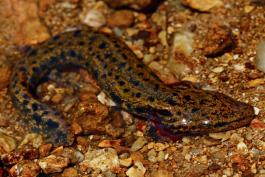












The mudpuppy is a permanently aquatic salamander with a gray-brown back and pale gray belly. It is mostly covered with numerous small, irregular dark brown to black spots that usually appear on the belly. Behind the head are plumes of red gills. The gills vary in size, depending on the oxygen content of the salamander's aquatic habitat. Fore- and hind limbs all have 4 toes. The eyes are small and lack eyelids.
All mudpuppy species (genus Necturus) have adults that are neotenic: they retain larval characteristics, namely the gills, into adulthood.
Similar species: Missouri has two species of mudpuppies. The species described above is Necturus maculosus, officially named the "mudpuppy" (sometimes still referred to as the "common mudpuppy").
- Missouri’s other mudpuppy species is the Red River mudpuppy, Necturus louisianensis. Until recently it was considered a subspecies of the above.
- It is smaller and has a lighter gray-brown or red-brown ground color. Dark spots on the upper part of the body are more distinct and more numerous. The belly has a wide, light, unspotted area down the center, which may be light gray with edges of pale pink.
- It does not grow as large as the mudpuppy; its maximum length is about 12 inches.
- The Red River mudpuppy has sometimes been called the Louisiana waterdog or Red River waterdog.
- In Missouri, the Red River mudpuppy occurs in the extreme southern part of the state.
- Note that hellbenders (Cryptobranchus spp.), once they reach 4 or 5 inches long, don’t have external gills.
Adult length: about 8–13 inches, but potentially up to about 19 inches. (Red River mudpuppies, in extreme southern Missouri, are somewhat smaller, with a maximum length of about 12 inches.)
Occurs throughout most of Missouri, except for the northwestern, north-central, and southern quarter of the state. Our other species, the Red River mudpuppy, replaces it in the southernmost quarter of the state, with records in Jasper, Newton, Barry, Stone, Christian, Taney, Douglas, Ozark, Shannon, Oregon, Reynolds, Carter, Ripley, Iron, Wayne, Butler, Stoddard, and Dunklin counties.
Habitat and Conservation
Mudpuppies are permanently aquatic. Missouri habitats include large creeks, rivers, and reservoirs. They can be found in muddy or gravel bottoms of shallow rivers and streams, and in deep pools in lakes.
Mudpuppies are usually inactive during the day; they usually remain hidden under submerged logs, rocks, boulders, debris piles, or tree roots.
Food
Mudpuppies feed at night on any aquatic animals small enough to be captured and swallowed, including crayfish, mollusks, small fish, worms, and aquatic insects (including insect larvae). They will also consume fresh carrion that they can readily locate by their keen sense of smell.
Life Cycle
Mudpuppies remain active all year. Mating occurs in fall and winter. Fertilization is internal, and eggs are laid the following spring or summer. A female can lay 30–200 eggs, usually attached to the underside of a large rock or similar object. She remains with the eggs until hatching, guarding them from predators. Incubation of the eggs may be 30–70 days. Hatchlings are about ¾–1 inch long and have prominent yellow yolk sacs.
Mudpuppy adults continue to guard the larvae for months after hatching. Mudpuppies reach sexual maturity in 4–6 years and can live for more than 30 years.
Human Connections
Mudpuppies are harmless to humans and to natural fish populations.
Anglers often catch mudpuppies on baited hook-and-line or in minnow traps. If caught, mudpuppies should be released unharmed.
Ecosystem Connections
Mudpuppies are an integral part of aquatic ecosystems. They prey on a variety of smaller animals and are preyed upon, themselves, by larger animals, including fish, watersnakes, and herons.
Mudpuppies' bodies vary with their particular aquatic environment. The size of their plumelike gills varies in relation to the oxygen content in the water. In slow, stagnant, warmer, lower-oxygen water, they develop larger gills; in faster, cooler water with a higher oxygen content, they have smaller gills.
Mudpuppies are the only host for the salamander mussel (Simpsonaias ambigua), an endangered species in Missouri:
- The tiny larvae of the mussel must attach themselves for a time to the mudpuppy's gills as external parasites. These larval mussels, called glochidia, are not harmful to their hosts.
- As an adult, this freshwater mussel reaches about 2 inches in length. Its range in Missouri is restricted to a few isolated locations within the Meramec River watershed.
- Most freshwater mussels use various types of fish as their hosts, so this one that uses mudpuppies as hosts is remarkable, which explains its name "salamander mussel."
Not counting extinct species, the mudpuppy and olm family (Proteidae) contains only two genera:
- Genus Proteus contains only one species: P. anguinus, the European olm. It is a slender, white, blind cave salamander that reaches a total length of about 10 inches. Native to the western Balkans and northern Italy, it has bright red gills, 3 toes on the front limbs, and 2 toes on the hind limbs.
- The second genus in family Proteidae is Necturus, which consists of eight species that live exclusively in North America. Called mudpuppies or waterdogs, they range across most of the eastern United States. They are totally aquatic, have permanent gills, and occur in a variety of aquatic habitats. Necturus maculosus and N. louisianensis are the only species represented in Missouri.