






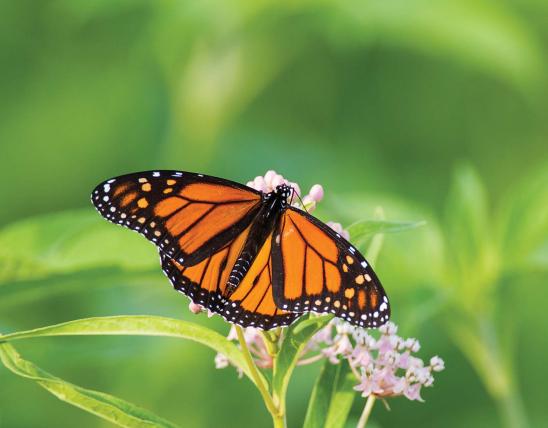




75. Behold Backyard Butterflies
Lots of colorful butterflies flutter by in summer. For a mini field guide to 10 of the most common ones, check out the May/June 2021 issue.
76. Grab a Buddy and Explore the Big Muddy
The Missouri River, nicknamed the “Big Muddy,” prompted writer Mark Twain to say, “The water is too thick to drink and too thin to plow.” Although he might be right, exploring one of the river’s sandbars or islands is a fun way to spend a sunny summer day.
June/July 2013
77. What Is It?
I arrive in the spring.
I’m covered in bling.
I eat on the wing.
I hum but don’t sing.
For the answer, go to No. 98.
April/May 2011
78. Explore a Pond
Pull on your rubber boots and grab a dip net. Summer’s a great time to explore a pond. There you’ll find insects that walk on water, beetles that dive with a bubble of air trapped against their bodies, and brightly colored newts that start life underwater, live on land for a few years, and then return to the water.
July/August 2015
79. Make Gourmet S’mores
The crunchy, gooey, yummy combination of graham crackers, chocolate, and roasted marshmallows — aka the s’more — has been satisfying hungry campers since before you were born. And though it’s tough to improve on a campfire classic, darn if we didn’t try. So if you want s’more ideas for ooey, gooey goodness, give “The Elvis” a try.
May/June 2018
80. Watch Fireflies
Fireflies talk to each other with light. A male firefly’s twinkling tush acts like a neon sign. “Here I am,” it blinks. “Do you like me?” Female fireflies blink back when they spot a male they fancy.
Why did the firefly dump her boyfriend? The answer is hidden in this series of blinks. Use the key to crack the code.
This key is based on International Morse Code, which uses dots and dashes (short and long sounds or flashes of light) to communicate a message. Here, yellow circles represent dots and black circles represent dashes. Real fireflies don’t use such a complex code.
May/June 2022
81. Snorkel an Ozark Stream
You don’t have to explore a coral reef or visit an aquarium to find flashy fish. Strap on a diving mask, peer into a clear Ozark stream, and you’ll be amazed at the rainbow of life you’ll find.
July/August 2022
82. Catch a Croaker
Bullfrogs can be as jittery as your little brother after his third can of cola. Sneaking close enough to grab one with your bare hands takes skill and luck.
1. At night, frogs cool off in mud along the shore. Slowly circle the bank, sweeping a flashlight all around. When you spot a frog, keep the light on its face.
2. Creep toward the frog from the front. If it startles, it might jump right toward you.
3. If it doesn’t spook, move your hand s-l-o-w-l-y within striking range and grab it! When you get your paws on a frog, hang on — they’re slippery!
June/July 2012
83. Go on a Dragon Hunt
It’s good that dragonflies aren’t dragon-sized. The buzzy, bug-eyed predators might be the best hunters in the animal kingdom. Studies have shown they catch nearly 95 percent of the insects they pursue. You can find them patrolling ponds, marshes, and streams. For a guide to common dragonflies, buzz over to the June/July 2014 issue.
84. Explore a Conservation Area
Conservation areas are great places to fish, hike, hunt, camp, or simply watch wildlife. Test-drive an outdoor adventure by reading the July/August 2021 issue, then get out and have a real-life adventure at one of more than 1,000 conservation areas scattered across the state.
85. Master the Art of Letting Go
Sometimes, rules require you to release a fish because it’s the wrong size. And sometimes, you’d rather fish for fun than for food. To avoid harming fish you free, follow these tips.
- Reel in your catch quickly. Fighting a fish longer than necessary weakens its ability to survive.
- Wet your hands before touching a fish and keep your fingers away from a fish’s gills and eyes.
- Keep a fish in the water when removing the hook. Its odds of survival drop the longer it’s out of water.
July/August 2025
86. Float Your Boat
When summer’s sizzle makes you fizzle, it’s time to paddle a raft down a cool Ozark stream.
July/August 2024
87. Stomp Around a Swamp
Some of Missouri’s most interesting plants and animals live in swamps. To see them, take a trip to Mingo National Wildlife Refuge or Otter Slough Conservation Area. There you’ll find bald cypress trees that breathe with their “knees,” swamp rabbits that dive underwater to escape predators, and neon-green treefrogs that honk like geese.
September/October 2017
88. Search for Silk Moths
To see a silk moth, you’ll probably need to stay up late. Most don’t come out until midnight. But it’s worth it to find these fuzzy, colorful giants fluttering around your porch light. For a guide to Missouri’s mega moths, check out the April/May 2012 issue.
89. Cook Your Catch
The only thing better than catching fish is eating fish. In our July/August 2017 issue we offered an easy recipe to turn your catch into crispy, tasty, golden-fried goodness.
90. Read a River
Paddling a canoe down an Ozark stream is a great way to beat summer heat. If you learn to read the water, you’ll get dunked only when you want to go swimming. One thing to watch for is an upstream “V.” When a rock or stump is submerged just below the surface, water flowing around it forms a “V” with the tip pointing upstream. If you see one, paddle around it! For more ways to read the water, check out the August/September 2013 issue.
91. Support Your Local Flower Farmers
Throughout the world, bees and other pollinators are disappearing in alarming numbers. You can help bring back the buzz in your own backyard.
- Plant a variety of native wildflowers so something is blooming from early spring through late fall.
- Ask your parents to avoid using pesticides. These chemicals don’t kill just pests. They also kill bees and butterflies.
- Mow your lawn less often. A few flowering weeds in a desert of grass is an oasis for thirsty pollinators.
July/August 2020
92. Seek a Skink
Six species of lizards called skinks slink under leaf litter and through rocky nooks and crannies across Missouri. For a guide to these colorful little lizards, check out the July/August 2026 issue.
93. Bake a Blackberry Cobbler
What should you do with the bucket of blackberries you’ve picked? Make a cobbler, of course! With this recipe, you sprinkle the berries on top of the cobbler, and they somersault under the batter as it bakes. You’ll flip, too, when you taste how yummy it is.
1. Preheat an oven to 400 degrees. In a mixing bowl, combine ½ cup of sugar and ¼ cup of shortening. Use a hand mixer to blend it until it’s creamy.
2. Mix in ½ cup of milk, ¾ cup of flour, 1 teaspoon of baking powder, and ¼ teaspoon of salt.
3. Grease a square 8-inch cake pan and pour in the batter.
4. Top the batter with 3 cups of blackberries. Drop flakes of butter (about 2 tablespoons) on top of the berries. Sprinkle ½ cup of sugar over the whole thing.
5. Bring ¾ cup of water to a boil and carefully pour it over the berries and batter.
6. Bake until the top of the cobbler turns golden-brown (about 30 minutes).
June/July 2010
94. Take Dad Camping
In the August/September 2012 issue, we tagged along with a group of kids who took their dad on his first-ever camping trip. Here’s a bit of advice they offered:
Practice setting up your tent at home. That way, you won’t hike five miles into the woods — like Dad did — only to discover you’re missing a tent pole. It also helps you learn to set your tent up quickly, in case you arrive at camp in the rain or after dark. If Dad had practiced beforehand, maybe we wouldn’t have wasted an hour trying to untangle him from the tent poles. That’s time a kid just can’t get back.
95. Shoot a Fantastic Photo
In the July/August 2018 issue, one of Xplor’s photographers, Noppadol Paothong, offered tons of tips for taking great nature photos. Here’s one:
How you place your subject in the frame can make or break a photo. If you don’t know where to start, try the “rule of thirds.” Pretend your camera frame is divided into thirds like a tic-tac-toe grid. Place your subject where the horizontal and vertical lines cross.
96. Interview a Trash Panda
In the July/August 2019 issue, we interviewed Missouri’s most mysterious masked mammal.
Xplor: Why are raccoons nicknamed “trash pandas”?
Raccoon: If dumpster diving were an Olympic sport, I’d be on a cereal box. Nothing better than dumpster doughnuts, am I right?
X: That explains the first part of your nickname. What about the panda part?
R: Some people think raccoons are related to giant pandas.
X: Are you?
R: All mammals are related, nature boy. But raccoons are more closely related to weasels than pandas. Personally, I don’t like trash panda. It’s rude. Call me raccoon or, if you want to sound smart, use my scientific name: Procyon lotor.
X: How do you spell that?
R: How should I know? I’m a raccoon.
97. Take a Hike
Hiking promises adventure — or at least something new to see — around every bend. Before you strike off for a walk in the woods, take this quiz to check your trail-trekking know-how.
The hiking trail zigzags down a steep hillside laced with ferns. Your buddy begins trudging down the path. You think it would be quicker to cut straight down the hill. What should you do?
1. Bellow “last one down’s a gassy skunk!” and plunge off through the underbrush.
2. Follow your hiking partner.
3. Yell “watch this!” then tuck into a ball and somersault downhill.
June/July 2011
98. Watch Brilliant Birds Battle
Ounce for ounce, ruby-throated hummingbirds might be Missouri’s angriest animals. When two of the sparkly, gem-colored birds arrive at the same feeder, one of them will fly into a sputtering, squeaking, feather-ruffling rage and chase the other hummer away. To see these harmless battles, put a sugar-water feeder near a window.
July/August 2016
99. Strange but True
Super-sized snack attack: Although full-grown bobcats rarely weigh more than 40 pounds, the ferocious felines have, on rare occasions, been known to take down adult white-tailed deer, which can weigh over 100 pounds.
January/February 2025
100. Keep on Xploring!
Each issue of Xplor, on average, contains about 10 illustrations, 50 photos, and 4,000 words — all about nature. After 100 issues, you might wonder if we’re running out of things to draw, photograph, and write about.
Not even close.
Nature is endlessly amazing. The closer you look, the more you find to explore.
We’re already hard at work on the next issue. And we’ve got lots more to show you after that.


And More...
This Issue's Staff
Photographer – Noppadol Paothong
Photographer – David Stonner
Designer – Marci Porter
Art Director – Ben Nickelson
Editor – Matt Seek
Subscriptions – Marcia Hale
Magazine Manager – Stephanie Thurber