








50. Munch on Morels
There’s a fungus among us and, wow, does it taste good. In April, mouthwatering morel mushrooms begin popping up on forest floors across Missouri. For tips on where to find morels and how to cook them, check out the April/May 2014 issue.
51. Go Fly Fishing
Trout and many other fish gobble down insects that live in or land on the water. Anglers use special gear to cast nearly weightless lures — called “flies” — that look like insects. For a beginner’s guide to fly-fishing, reel in the March/April 2020 issue.
52. Strange but True
Before going number two, a river otter often shuffles from one back foot to another, shaking its furry bottom in what some biologists call a “poop dance.”
November/December 2023
53. Survey a Snag
Even after death, trees provide homes and food for lots of life. Beetles and mushrooms eat dead trees from the inside out. Woodpeckers hammer holes to find food and make nests. And lots of animals — from bears to butterflies — use hollow cavities inside dead trees for shelter.
March/April 2021
54. Plant a Tree
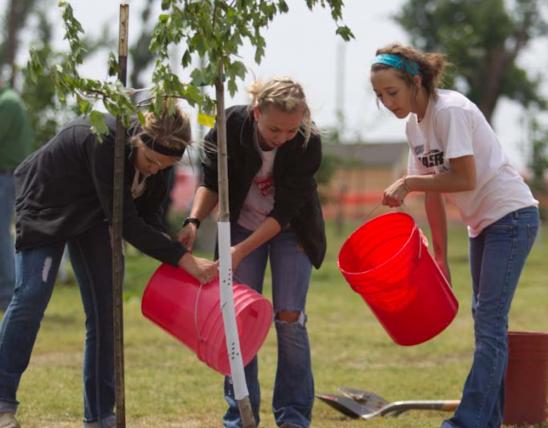
Arbor Day, which Missourians celebrate on the first Friday in April, is about appreciating trees. And why not? Trees clean the air, keep soil from washing into rivers, provide homes for animals, and offer shade to people. So what’s the best way to celebrate this leafy green holiday? Plant a tree, of course! For tree-planting tips, check out the April/May 2013 issue.
55. Meet Some Animal Architects
No hammer? No nails? No problem. Even without boards or blueprints, animals like beavers, orioles, and mud daubers build impressive homes. Spring is a great time to take a walk and look for animal architects at work.
March/April 2023
56. Snag a Paddlefish
Paddlefish, also known as spoonbill, are unlike anything else you’ll see on the end of your fishing line. Few of Missouri’s fish grow as large, and none of them have a paddle for a snout! Paddlefish season starts on March 15. Find out more at short.mdc.mo.gov/opU.
February/March 2014
57. What Is It?
I spend my days on rocky glades.
Soaking up sun or hiding in shade.
Colorful scales I’ve got in spades.
I run real fast when I’m afraid.
For the answer, go to No. 72.
May/June 2023
58. Spot Some Wandering Warblers
Over 30 kinds of warblers wander through Missouri in May. Some stay here to nest. Others grab a quick bite to eat and keep flying north. Woodlands throughout the state serve as “gas stations” where these colorful, insect-eating birds refuel for their long, nighttime flights. Learn what a few of Missouri’s warblers look like by matching the bird’s name from the list to the branch where it’s perched. (American redstart, bay-breasted, blackburnian, black-and-white, Cape May, cerulean, Kentucky, magnolia, prairie) The first letter of each name will be in the space directly below the bird. Spaces between words have been removed, so “Cape May” will be written “CapeMay.”
May/June 2015
59. Attend a Spring Symphony
Nature puts on a concert every spring, and you don’t need tickets to attend. Just head outside at sunset and explore marshes, ponds, and flooded ditches. As the sun sinks, the show kicks into full swing when each puddle and pool overflows with a chorus of singing frogs and toads. For a guide to crooning croakers, check out the March/April 2025 issue.
60. Keep Little Critters Safe
If you find a fawn on your lawn or a baby bird in a bush or a nest of tiny rabbits, the best thing you can do is leave them alone. They may look abandoned, but their moms are likely hiding nearby, waiting for you to leave so they can check on their little critters.
April/May 2010
61. Whittle a Hickory Whistle
1. Saw off a hickory branch that’s about ¾ inch thick and 8 to 12 inches long. Examine the branch closely before you cut. If it has lots of knots or scars, choose another. Trim one end of the stick so it’s flat.
2. Make a notch. One inch from the trimmed end, cut straight down into the stick about 1/3 of the way through. Move half an inch farther down and shave a sloping cut that meets the straight-down cut you just made.
3. An inch down from the notch, cut a ring completely around the stick. Cut through the bark but not all the way through the stick.
4. Use another stick to gently pound the bark between the ring cut and the flat end until sap leaks out of the cuts. Twist and pull the loosened bark off the wood in a single, unbroken tube. This is the mouthpiece. Set it aside.
5. Saw off the section of the stick from the end to the notch. Turn this section on its end. Use your knife to cut down and take off a thin sliver from the entire section. This is the plug. Set it aside.
6. Whittle the exposed wood that’s left on the stick so that it tapers gently. This is the endpiece.
7. Slide the plug into the mouthpiece. Make sure the flat part of the plug faces upward toward the notch on the mouthpiece. Slide the mouthpiece onto the endpiece.
Blow on the mouthpiece. If you did everything right, a clear whistle should ring out. To keep your whistle working, keep it in a glass of water.
May/June 2016
62. Go on a Wildflower Walk
In early March, Missouri looks gray and bare. But if you take a walk in the woods, you might find colorful signs of spring poking up through the leaf litter. Every week in March and April, take a wildflower walk to see which new flowers have unfurled. For a guide to the blooming beauties you might behold, check out the March/April 2017 issue.
63. Go on a Turtle Safari
Every spring, turtles awake from their winter sleep and plod or paddle across Missouri’s hills and waterways to search for warm places to bask. This makes April the perfect month for a turtle safari. Watch for box turtles trudging across roads, check each log in a lake for painted turtles, and search streams for river cooters. For a mini field guide to 10 terrific turtles, crawl over to the May/June 2017 issue.
64. Play in the Mud
Wild critters don’t mind a mess. In fact, they use oozy, gooey, sticky, squishy mud to build homes, keep cool, and find food. Visit a mud hole this spring, and you might be surprised at who else stops by.
March/April 2018
65. Hunt Creepy-Crawly Creek Critters
Biologists call the squiggly, little creepy-crawlies living in a stream “benthic macroinvertebrates.” Though that may be a mouthful to say, they’re fun to catch, and they offer clues about the health of a stream.
1. Find a riffle where shallow water tumbles over rocks.
2. Anchor a dip net in the riffle and stand upstream.
3. Do the benthic boogie: Shuffle your feet in the stream gravel and scrub rocks with your hands. This will dislodge creatures clinging to the rocks, and some of them will flow into your net.
4. Use tweezers to gently pick macroinvertebrates out of your net. Place them in a white ice cube tray filled with water from the stream.
5. When you’re done observing your catch, return the creatures to the place where you collected them.
March/April 2019
66. Meet the Beetles
Some are mighty. Some are tiny. Some are dull. Some are shiny. Biologists have named 250,000 to 400,000 kinds of beetles, and they come in more sizes, shapes, and colors than any other animal on Earth. To see a few of Missouri’s most bodacious beetles, crawl over to the May/June 2020 issue.
67. Eat a Tree
Did you know you can eat a tree? The pink flowers on a redbud tree taste nutty and sweet. The best way to sample them is to bury your face in a branch and nibble away like you’re eating corn on the cob. Just watch out for bees — they like redbuds, too.
March/April 2015
68. Celebrate a Wild Mother’s Day
Wild mamas like bears spend months raising their babies, and others like turtles just look for the best place to lay their eggs. Either way, animal moms spend tons of energy bringing young critters into the world. Spotting wild families in Missouri’s woods, prairies, and streams is one of the best things about spring. Thanks, Mom!
May/June 2019
69. Go on a Salamander Safari
On warm, rainy nights in late February, head outside with a flashlight and search the shores of shallow, fish-free ponds. You might find dozens of salamanders marching toward the water, hoping to find a mate and lay eggs.
March/April 2022
70. Make Butterfly Bombs
1. In a mixing bowl, combine 5 parts powdered clay, 5 parts potting soil, and 1 part wildflower seeds.
2. Add a tiny bit of water. You’ll need just enough to make a thick, clay-like dough.
3. Use your hands to roll the mixture into balls the size of large gum balls.
4. Put your butterfly bombs on an old newspaper and let them harden in a cool, dry place for at least three days.
5. Toss your butterfly bombs wherever you want flowers to grow.
February/March 2012
71. Catch a Courtship
Cute and cuddly doesn’t cut it for female cottontails. They want brawny boyfriends. To show how tough they are, male rabbits punch and bite each other. Sometimes, one of the flop-eared fighters will leap high into the air and try to kick his opponent as he sails overhead. The rabbit that loses stays lonesome. The winner gets the girl. For more examples of the weird, wacky, and wild ways animals woo a mate, hop over to the February/March 2010 issue.
72. Explore a Glade
Rocky, sun-scorched glades get toasty, but the animals that live there are super cool. Explore a glade in the spring to see grasshoppers that look like lichens, colorful collared lizards doing pushups to impress a mate, and maybe even a roadrunner running around looking for lunch.
May/June 2025
73. Catch a Crayfish
Crayfish can be found crawling around rocks at the bottom of shallow streams. You can scoop them up using an aquarium net, but it’s more fun to catch them with your bare hands.
1. Crayfish escape predators with a quick flip of their tail, which causes them to rocket backward in the water. Because of this, approach a crayfish from behind.
2. Once you’ve spotted a crayfish, slowly lower your hand into the water. Be careful not to splash or make sudden movements.
3. When your hand is just an inch or two away, reach quickly but gently to grab the crayfish.
4. To keep from getting pinched, hold the crayfish by the hard, saddlelike shell just behind its claws. After you’ve gotten a good look, put the crayfish back where you found it.
May/June 2026
74. Get Motivated by a Box Turtle
In the March/April 2024 issue, Doug Holey, a box turtle and motivational speaker, offered this advice:
You know what’s worse than living in a van down by the river? Getting crushed trying to cross the street! Thousands of box turtles get hit by cars in April and May. You can help. Look both ways to make sure there aren’t any cars coming, then carry turtles to the side of the road in the direction they were crawling.


And More...
This Issue's Staff
Photographer – Noppadol Paothong
Photographer – David Stonner
Designer – Marci Porter
Art Director – Ben Nickelson
Editor – Matt Seek
Subscriptions – Marcia Hale
Magazine Manager – Stephanie Thurber