









This amendment updates camping regulations to require the proposed new Five-Day Camping Permit and addresses challenges associated with area misuse. This amendment also reorganizes the rule to improve readability and clarity.
Acknowledgements
Title 3 – Department of Conservation
Division 10 – Conservation Commission
Proposed Amendment
Proposed Amendment
(1) [Camping is permitted only within areas designated by signs, area maps, or in accordance with posted regulations or by special use permit. Stays are limited to a period of fourteen (14) consecutive days in any thirty- (30-) day period, with the period to commence the date the site is occupied or camping within any given department area first occurs. Personal property must be removed at the end of the fourteen- (14-) day period. Total camping days on all department lands are limited to thirty (30) days within one (1) calendar year. Camping requests in excess of thirty (30) days within a calendar year may be granted with a special use permit. On those areas with established campsites, only two (2) camping or sleeping units are permitted in each site. Quiet hours are effective from 10:00 p.m. to 6:00 a.m. daily. Visitors who are not occupying a campsite are required to leave the campground by 10:00 p.m. Quiet hours are defined as the cessation of excessive noise from people or any mechanical device which causes disturbance to other campers. Campfires are allowed only in designated camping areas or by special use permit. Groups of more than ten (10) people must obtain a special use permit prior to camping.
(A) On Thomas Hill Reservoir, only one (1) camping or sleeping unit and a maximum of six (6) people are permitted in each campsite.]Camping or establishing temporary overnight accommodations on department areas is authorized only as permitted in this rule.
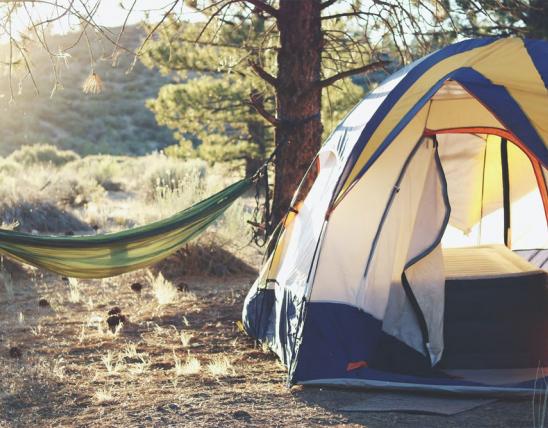
(2) A Five-Day Camping Permit is required to camp or otherwise establish temporary overnight accommodations on department areas. The Five-Day Camping Permit is valid for one (1) group of campers with a maximum of ten (10) people and two (2) sleeping units. In addition to the prescribed camping permit, any group of more than ten (10) people or more than two (2) sleeping units must obtain a special use permit prior to camping. For the purposes of this rule, sleeping units are temporary accommodations for overnight occupancy, including tents, recreational vehicles (RVs), camper vans, camping trailers, vehicles, and other portable devices used for shelter or sleeping.
(A) At least one (1) member of a group of campers must first obtain the prescribed camping permit. All members of a group of campers shall be jointly liable for obtaining the prescribed permit prior to camping or establishing temporary overnight accommodations on a department area and for complying with the requirements of this rule. The holder of the camping permit must be camping on site.
(B) Camping is only permitted within specified locations of department areas designated in the online conservation atlas or by special use permit.
(C) The length of stay for any person camping or establishing temporary overnight accommodations on all department areas shall be limited to the following:
1. No person may stay under the authorization of more than three (3) consecutive camping permits.
2. No person may stay under the authorization of more than six (6) camping permits from January 1 through December 31 each year.
(D) Each sleeping unit must be plainly labeled on durable material with the full name and address, or conservation number, of the permit holder. The label must be visible from the outside of the sleeping unit.
(E) Personal property may not be left unattended for more than twenty-four (24) hours and must be removed no later than the final day of the authorized camping period.
(F) Quiet hours are effective from 10:00 p.m. to 6:00 a.m. daily. Visitors who
are not staying under a valid camping permit are required to leave the
campground by 10:00 p.m. Quiet hours are defined as the cessation of
excessive noise from people or any mechanical device which causes
disturbance to other campers.
(G) Campfires are allowed only in designated camping areas or by special
use permit. The collection of dead and downed woody vegetation is allowed only for on-site campfire use and may not be transported from the conservation area.
AUTHORITY: sections 40 and 45 of Art. IV, Mo. Const. and section 252.040, RSMo 2016.* This rule previously filed as 3 CSR 10-4.115. Original rule filed April 30, 2001, effective Sept. 30, 2001. For intervening history, please consult the Code of State Regulations. Amended: Filed June 10, 2026.
PUBLIC ENTITY COST: This proposed amendment will cost state agencies or political subdivisions an estimated sixty thousand seven hundred dollars ($60,700) in the aggregate.
PRIVATE ENTITY COST: This proposed amendment will not cost private entities more than five hundred dollars ($500) in the aggregate.
NOTICE TO SUBMIT COMMENTS: Anyone may file a statement in support of or in opposition to this proposed amendment with Regulations Committee Chairman, Department of Conservation, P.O. Box 180, Jefferson City, MO 65102-0180, or via the department’s website at https://short.mdc.mo.gov/Z49. To be considered, comments must be received within thirty (30) days after publication of this notice in the Missouri Register. No public hearing is scheduled.
FISCAL NOTE
PUBLIC COST
I. Department title: Department of Conservation
Division title: Division 10 – Conservation Commission
Chapter title: Chapter 11 - Special Regulations for Department Areas
| Rule number/name: | 3 CSR 10-11.140 Camping |
| Type of rulemaking: | Proposed Amendment |
II. SUMMARY OF FISCAL IMPACT
| Affected Agency or Political Subdivision | Estimated Cost of Compliance in the Aggregate |
| Missouri Department of Conservation | $60,700 |
III. WORKSHEET
The department’s software developer estimates a one-time cost of $60,700 to update the online conservation atlas with updated camping information.
IV. ASSUMPTIONS
This is a one-time update and no assumptions have been made.