










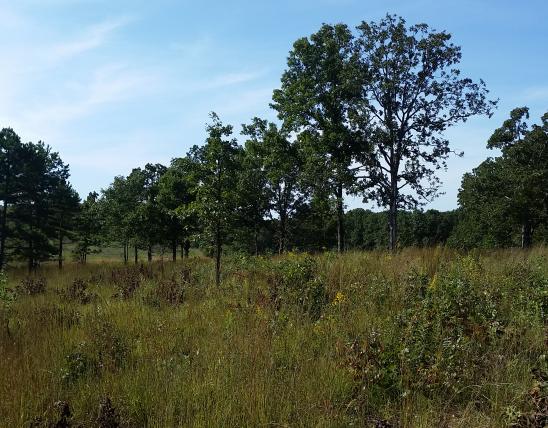
Canaan Conservation Area is located in Gasconade County, near Bland. Take Route A about 1.2 miles north from Bland to the Conservation Area's southern most access road.
Media
Scientific Name
Anaxyrus americanus (formerly Bufo americanus)
Family
Bufonidae (true toads) in the order Anura (toads and frogs)
Description
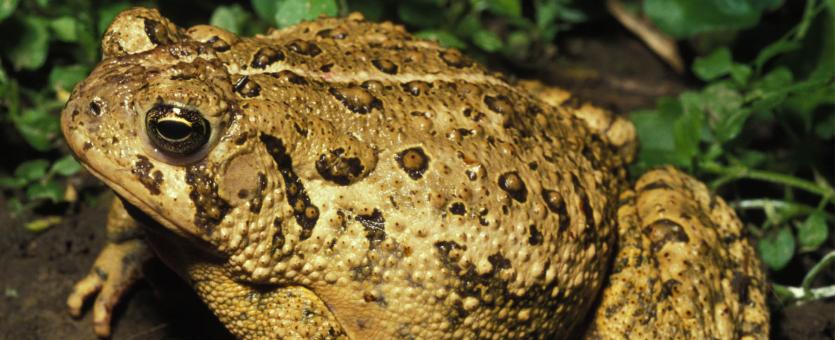
American toads are Missouri’s most familiar toads. They have a wartlike, kidney-shaped gland (parotoid gland) behind each eye. The bony ridge above each eye usually does not touch the parotoid gland, but it may be connected to it by a small spur.
The general color is gray, greenish gray, brown, or reddish brown. Blackish spots may be present on the back, and these may encircle 1 or 2 warts. There might be a narrow, light stripe down the back. The belly is white, mottled with dark gray, or cream-colored, with dark gray spots on the breast.
The male’s call is a sustained, high-pitched trill lasting 6–30 seconds.
Missouri has two subspecies of American toad; they live in different parts of the state:
- The eastern American toad (Anaxyrus americanus americanus) is generally larger than the dwarf subspecies. Its belly is white, mottled with dark gray.
- The dwarf American toad (Anaxyrus americanus charlesmithi) is generally smaller than the eastern American toad subspecies. Otherwise, it is very similar. Its ground color is more likely to be reddish brown, and the size and number of dark spots on the back are reduced or absent. The belly is cream colored with a small number of dark gray spots on the breast. Its call is similar to the eastern American toad but is slightly higher in pitch.
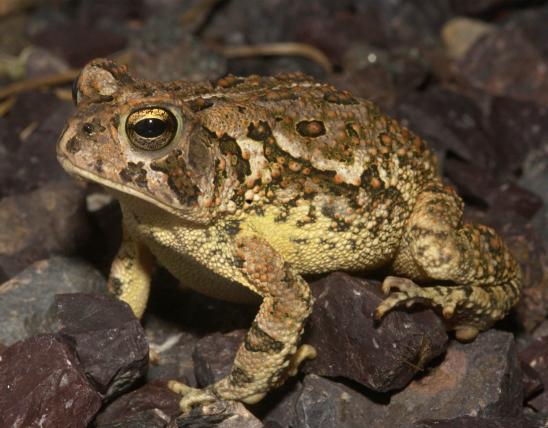
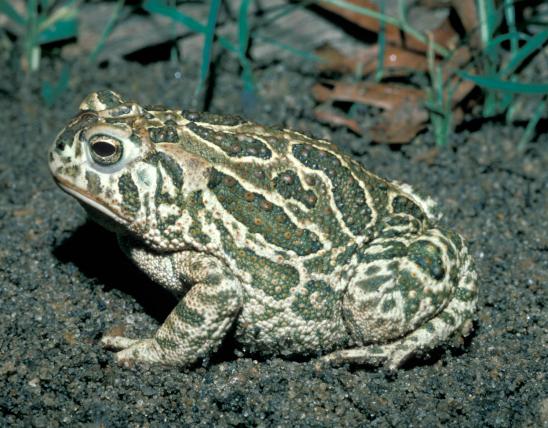
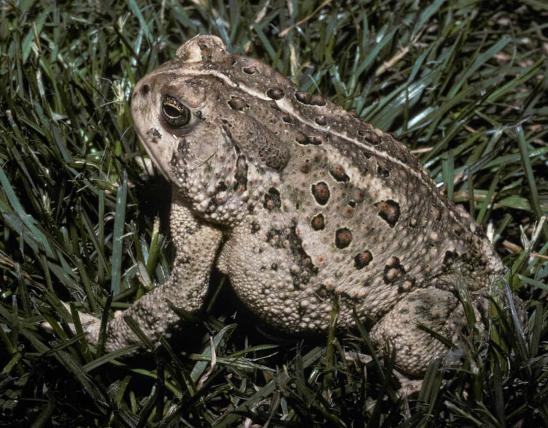
Similar species: The two subspecies of the American toad in Missouri have been known to hybridize with the Fowler’s toad (Anaxyrus fowleri) and the Rocky Mountain toad (Anaxyrus woodhousii woodhousii) in some parts of the state. The offspring of these crossbreedings are very difficult to identify because they often have characteristics of both species.
Size
Eastern American toad adult length (snout to vent): 2–3½ inches; occasionally to 6 inches. Females are generally larger than males. The dwarf American toad is smaller, averaging about 2 inches in length.
Where To Find
The American toad species occurs statewide. The eastern American toad subspecies occurs throughout the northern half of the state, but it intergrades with and is replaced by the dwarf American toad subspecies in the southern half of the state. There is a wide band of intergradation between these two subspecies along a line from St. Louis to northern Joplin.
Habitat and Conservation
American toads can be found in nearly any land habitat in Missouri, but they prefer rocky, wooded areas. They often live along the edge of hardwood forests. They are also found in disturbed habitats, such as urban and suburban, agricultural, and mined sites. People often see them in backyards, parks, and gardens.
This species more commonly lives in upland habitats compared to the Rocky Mountain toad and Fowler’s toad. The latter two occur more often in lowlands and river floodplains.
Individuals hide during the day under rocks and logs where there is loose, moist dirt, or they burrow into a depression where dead leaves have accumulated. Like most toads, this species becomes active at dusk.
All of Missouri’s species of true toads are primarily nocturnal, seeking shelter during the day among piles of dead leaves, under rocks and logs, or in loose soil.
Food
American toads eat earthworms and a wide variety of insects. Toads are well-known for their consumption of large numbers of insects. During summer nights, toads often catch and eat insects as they fall to the ground under outdoor lights.
Status
Missouri’s most common toads.
Life Cycle
Life Cycle
In Missouri, male American toads begin calling on warm nights in mid-March and early April. Breeding peaks from late April into May, and calling continues into July. Breeding sites include temporary pools (such as water-filled ditches and road ruts), permanent ponds (such as natural sinkhole ponds and human-made ponds), and slow, shallow streams.
Females lay eggs in long, double strands, depositing them on the bottom in shallow water or entwined in aquatic plants. A female can lay 2,000–20,000 eggs. After about a week, these hatch into tiny black tadpoles. The tadpoles often swarm in shallow water near the shore. The tadpoles remain in water until late June into July, when they transform into small toadlets about ½ inch long.
American toads can live about 4–5 years.
Human Connections
Contrary to superstition, toads do not cause warts on humans. They are harmless.
Despite toads’ complexion and dour countenance, many people find them endearing.
During summer nights, toads help us by consuming insects and other small organisms that are pests or annoyances to us and our gardens.
Extensive, human-created habitat disturbance is one cause for hybridization to occur among toad species and subspecies.
The subspecies name of the dwarf American toad, charlesmithi, honors the biologist Charles Clinton Smith (1910–1966), a colleague of Arthur Bragg, who first described the subspecies. A native of Kansas, Smith taught at colleges in Kansas, Oklahoma, Louisiana, and Arkansas. He worked with the Civilian Conservation Corps and the Oklahoma Biological Survey and was a soil conservationist for the USDA.
Ecosystem Connections
Toads are predators that help keep populations of insects and other small animals in balance.
American toads and their eggs, tadpoles, and toadlets, are eaten by aquatic and land predators ranging from water bugs and fish to grackles and raccoons. The numerous warts over most of a toad’s body are a form of defense. The warts secret toxins that are irritating to a predator’s mucous membranes.
Even though American toads can lay a large number of eggs, there is no guarantee that the tadpoles will survive to metamorphosis.
American toad eggs and tadpoles can have a mutually beneficial relationship with green algae. The algae apparently provides oxygen to the embryos, and the developing larvae provide carbon dioxide and waste products that can be used by the algae.
There's a group of insects called toad bugs, which look a great deal like miniature toads. They even hop! They live along stream banks and, like their namesakes, are well camouflaged.
Title
Media Gallery
Image

Caption
American toad
Credit
MDC Staff
Right to Use
Photo by MDC Staff, courtesy Missouri Department of Conservation
Video file
Caption
Video of American toad in the wild.
Credit
Kevin Muenks
Audio file
Caption
Audio of an American Toad.
Image

Thumbnail

Thumbnail
Title
Similar Species
Similar Species
Media
Media
Media
Media
Media

Media

Where to See Species
About Reptiles and Amphibians in Missouri
Missouri’s herptiles comprise 43 amphibians and 75 reptiles. Amphibians, including salamanders, toads, and frogs, are vertebrate animals that spend at least part of their life cycle in water. They usually have moist skin, lack scales or claws, and are ectothermal (cold-blooded), so they do not produce their own body heat the way birds and mammals do. Reptiles, including turtles, lizards, and snakes, are also vertebrates, and most are ectothermal, but unlike amphibians, reptiles have dry skin with scales, the ones with legs have claws, and they do not have to live part of their lives in water.
Reviewed On