


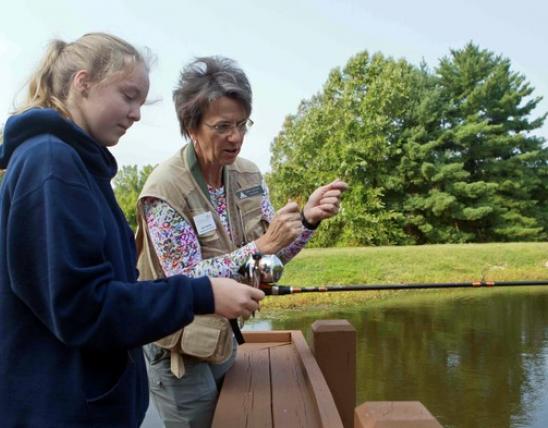
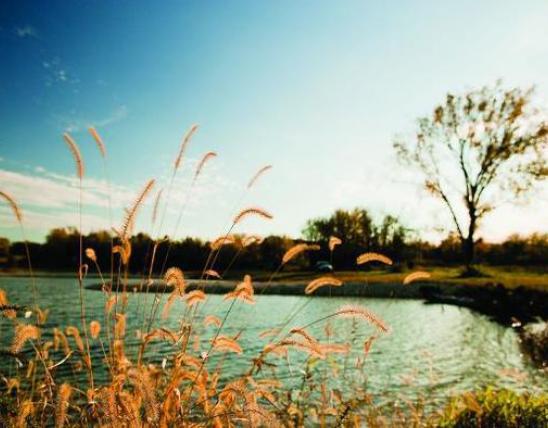
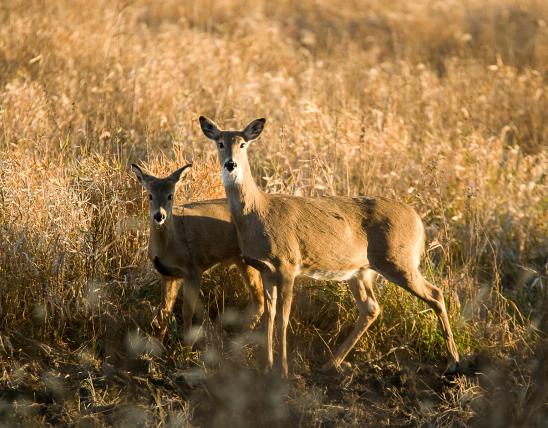




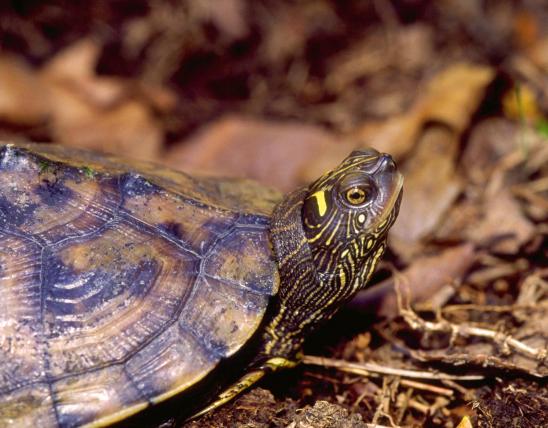

The Rocky Fork Lakes Conservation Area is located in Boone County approximately six miles north of Columbia on Highway 63 and one-half mile east on Peabody road.
Media

Scientific Name
Terrapene triunguis
Family
Emydidae (basking, marsh, and box turtles) in the order Testudines (turtles)
Description
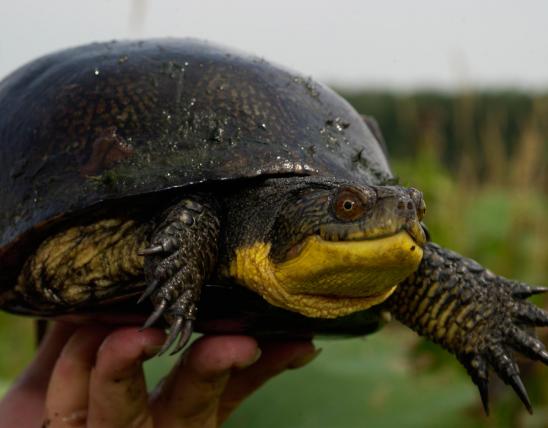
The three-toed box turtle is a small, land-dwelling turtle with a high-domed shell and normally 3 toes on each hind limb. There is usually a ridge along the center of the top shell (carapace). The carapace may be olive or olive brown with faint yellow or orange lines radiating from the center of each large scute (shell scale). The lower shell (plastron) has a distinct, single hinge across the forward third of the shell; it allows the turtle to close the lower shell tightly against the inside edge of the upper shell. The plastron is plain yellow or yellow with brown smudges or lines that sometimes follow the scute seams.
The exposed skin is dark brown or black; the scales on the head and forelimbs may be yellow or orange. The entire head and portions of forelimbs of males are often bright orange.
Most adult males can be distinguished from females by the greater amount of orange on the head and neck, thicker tail, slightly concave plastron, and often red eyes. Adult females have a very small tail and most have yellow-brown eyes.
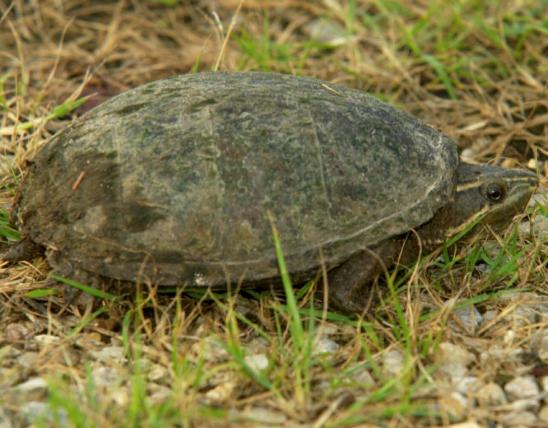
Similar species: The ornate box turtle (T. ornata) usually has 4 toes on each hind leg, lacks a ridge along the center of the top shell, and the top shell is usually brown with numerous yellow lines radiating from the center of each plate. It is more of a grassland species than the three-toed box turtle and is found statewide except for the Bootheel.
Size
Adult upper shell length: 4½–5 inches; occasionally to 7 inches.
Where To Find

Occurs statewide, except for extreme northern and northwestern parts of the state. Along the eastern and southeastern edge of the state, our "three-toed" subspecies intergrades with the eastern box turtle subspecies, which occurs mostly east of the Mississippi River. In this zone along the Mississippi River, individuals may show characteristics of both subspecies.
Habitat and Conservation
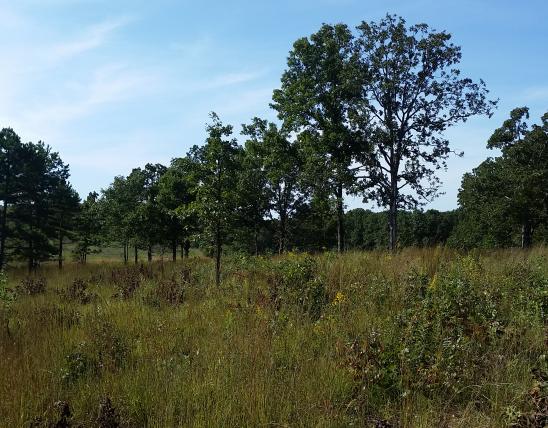
This is the common box turtle of Ozark woodlands. It is mainly active from early April through late October. Although it mainly inhabits open woodlands throughout Missouri, grasslands are important during parts of the active season.
The typical daily routine for a three-toed box turtle usually begins with a period of feeding followed by basking in the sun in an open area. In warm weather, box turtles will crawl into a clump of dense grass or dead leaves and rest. In early evening, they usually search for a suitable retreat for the night. These retreats, called forms, are often under leaf litter or in a few inches of soil.
In central Missouri, three-toed box turtles prefer mature oak-hickory forests with numerous openings and edge areas along brushy fields. The home range of adults varies from about 5 to 26 acres. Adults can find familiar habitat when displaced several miles. Some individuals stay within the same home range for up to 35 years.
A study in Arkansas noticed a seasonal shift in habitat use: in this case, the turtles were most often found in wooded areas near overwintering sites in late autumn and early spring; the turtles then moved to grasslands during late spring, then back into wooded areas during the heat of summer, and finally back to grasslands in early autumn prior to moving to overwintering sites in wooded areas. A study in southwestern Missouri showed a similar pattern in habitat use between grasslands and wooded areas. The use of grasslands by box turtles coincided with mild temperatures and high moisture conditions.
During hot, dry conditions in late summer, three-toed box turtles are often found in temporary pools or in the water along the shallow margins of a pond. They will readily swim across rivers and lakes. Most individuals were observed swimming at the surface of the water, and some individuals were observed sitting on the bottom.
The three-toed box turtle’s inability to dig deep enough into leaf litter and soil during cold weather is thought to cause a high incidence of winter mortality. However, some studies of box turtles indicates that their bodies produce a type of blood/tissue antifreeze when their liver releases glycogen into the circulatory system. This allows the turtles to survive freezing during the winter and causes the heart and blood vessels to continue to function.
In spring, three-toed box turtles begin to move closer to the surface when the temperatures reach 45°F and begin to emerge after five consecutive days of increasing temperatures, in about early April. Once emerged, they remain near their overwintering site until warm spring rains occur.
Food
Young three-toed box turtles consume mostly earthworms and insects, but older turtles eat a proportionately larger amount of plant matter and fungi, including berries, mushrooms, and young shoots of various plants and grasses. Adults will occasionally consume earthworms, snails, and insects. A study in southwestern Missouri found the majority of their diet was dogwood berries in the fall and blackberries in the summer, although some insects were eaten.
In years when periodical cicadas make their massive emergences, three-toed box turtles are one of the species that feast on the multitudes of cicadas.
Status
The three-toed box turtle can be abundant, especially in its preferred habitat of oak-hickory woodlands. Turtles have generally been declining statewide, mainly due to loss of habitat. Although this turtle is still quite common and widespread in Missouri, it does face many threats.
There is also a heavy demand for box turtles overseas, especially for the European pet trade. This has resulted in the illegal commercial collecting of this species. Fortunately, the Missouri Department of Conservation has protected the box turtle from being collected and sold as pets. Box turtles are not easy to keep as pets and generally slowly starve to death or develop abnormally. These reptiles are an interesting part of outdoor Missouri and should not be kept in captivity.
Life Cycle
Life Cycle
Three-toed box turtles become active between late March and late April, after the last killing frost.
Courtship and mating usually occur from late April to early July in Missouri, although mating is also regularly observed in late summer into fall. The male courts by pulsating his orange throat. Most egg-laying occurs from mid-May to early July. At around dusk, the female selects an elevated, open patch of loose soil or sand and digs a hole 3–4 inches deep with her hind legs. A clutch is usually 2–8 eggs, which hatch in about 3 months. There may be multiple clutches each season. Eggs laid late in the summer will hatch in the fall, and the hatchlings will remain within the nest until the following spring.
Shortly after the first killing frost of autumn, usually between mid-September and early November, they dig into leaf litter and soil and go dormant to survive winter.
Three-toed box turtles become sexually mature between 7 and 10 years of age. The life span can be 50–80 years, but there are records of them living for more than 100 years. The maximum longevity in Missouri is almost certainly more than 70 years.
Human Connections
The three-toed box turtle is familiar to most Missourians, and it is fitting to be named the official state reptile. Although this turtle is still quite common and widespread in Missouri, it does face many threats. Humans can take actions to help conserve these beloved animals and other species.
Many box turtles are captured by people on weekend outings and taken home to be kept as a pet. Such captive conditions are in direct conflict with the biological needs of these turtles; they may slowly starve to death or grow abnormal shells, claws, and jaws if not maintained and cared for correctly. These reptiles are an interesting part of outdoor Missouri and should not be kept in captivity.
Of all the reptiles, turtles are the most admired by humans for their symbolic characteristics of slow, steady progress, longevity, and resilience as well as for their unique body form.
Thousands of box turtles are killed annually while crossing roads and highways, especially in May. Follow the speed limit, avoid tailgating, and keep your eyes on the road.
Among the many contributions to conservation made by Charles W. and Elizabeth R. Schwartz are their extensive studies of three-toed box turtles published in 1974, 1984, and 1991. For 25 years they tracked the home ranges, movements, populations, and survival statistics of 1,743 box turtles in central Missouri. Much of our life-history information on this species comes from their detailed studies.
Ecosystem Connections
Even though adult box turtles are defended by their shells, the eggs and young provide food for many predators. Hatchlings are only about 1 inch long and are especially vulnerable. Box turtle eggs and young are eaten by skunks, raccoons, and badgers. The primary causes of death in adults are diseases, extreme cold during the winter (with no snow cover for insulation), and human activities.
Missourians sometimes report finding 10–25 dead box turtles together in a relatively small area in a forest. What happened? There are a few possible explanations. During warm spells in the winter, individuals may emerge too early and then be killed by a quick decline in temperature. It might also be that the turtles die of a disease while in their overwintering burrows and are scavenged by mammals in midwinter.
The occasional appearance of the eastern box turtle subspecies in Missouri, along the Mississippi River, may be due to several causes. Where they appear in undeveloped rural or wild habitats, they may represent a link to the Illinois population resulting from historic changes in the Mississippi River channel. We also must assume that some eastern box turtles were brought to Missouri from Illinois by people. Others may have been left on the Missouri side of the Mississippi River as the river migrated across its historic floodplain years ago, or individuals may have swum the Mississippi River, thus colonizing eastern Missouri.
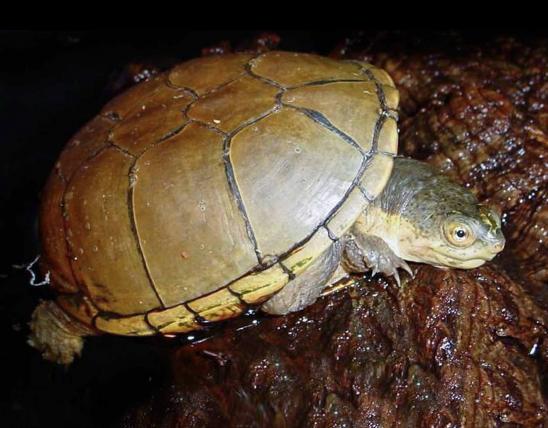
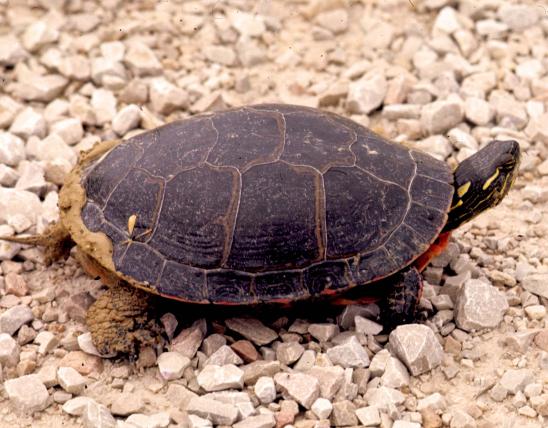
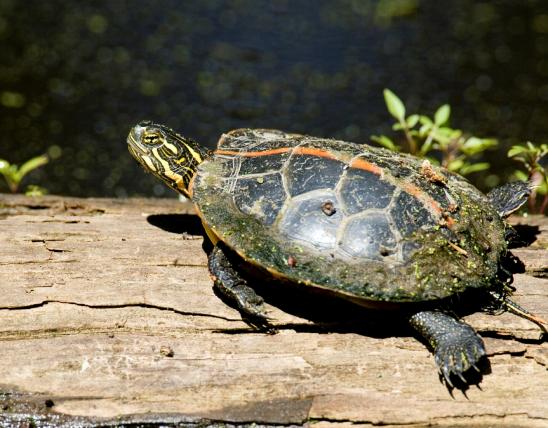
The three-toed box turtle is a member of family Emydidae (the pond and box turtle family). This is one of the largest families of living turtles in the world. It comprises 12 genera, containing 52 species. In general, turtles in this family are small to medium sized and are adapted to a variety of habitats. This family includes several colorful species. Although the majority of species are aquatic (such as the eastern river cooter, red-eared slider, and the painted and map turtles), several kinds are either semiaquatic or have taken to life on land (for example, the box turtles). In Missouri, this family is represented by 7 genera with a total of 11 species and 1 additional subspecies.
Title
Media Gallery
Image

Caption
Three-toed box turtle
Right to Use
Use of this image is restricted to MDC only
Video file
Caption
Video of box turtles in the wild.
Right to Use
Image

Caption
Three-Toed Box Turtle in Rock Bridge Park
Credit
Submitted by Bert Schreuders
Right to Use
Use of this image is restricted to MDC only
Image

Credit
Submitted by Andrew Fabula
Right to Use
Use of this image is restricted to MDC only
Image

Credit
Submitted by Jessica Ross
Right to Use
Use of this image is restricted to MDC only
Image

Caption
In fall, soon after the first hard frost, three-toed box turtles dig into leaf litter and soil and go dormant to survive winter.
Credit
Julianna Schroeder
Right to Use
Use of this image is restricted to MDC only
Image

Thumbnail

Image

Image

Image

Image

Title
Similar Species
Similar Species
Media

Media
Media
Media
Media
Media
Where to See Species

LaBarque Creek Conservation Area is one of the finest outdoor destinations in Jefferson County.

Sycamore access is located along Bryant Creek on the downstream side of the Hwy 181 bridge. The area is adjacent to the privately owned historic Hodgson Water Mill built in 1897.
Canaan Conservation Area is located in Gasconade County, near Bland. Take Route A about 1.2 miles north from Bland to the Conservation Area's southern most access road.

Arrow-Wood Conservation Area is located near the center of Shelby County, 2.5 miles north of Shelbina.
About Reptiles and Amphibians in Missouri
Missouri’s herptiles comprise 43 amphibians and 75 reptiles. Amphibians, including salamanders, toads, and frogs, are vertebrate animals that spend at least part of their life cycle in water. They usually have moist skin, lack scales or claws, and are ectothermal (cold-blooded), so they do not produce their own body heat the way birds and mammals do. Reptiles, including turtles, lizards, and snakes, are also vertebrates, and most are ectothermal, but unlike amphibians, reptiles have dry skin with scales, the ones with legs have claws, and they do not have to live part of their lives in water.