

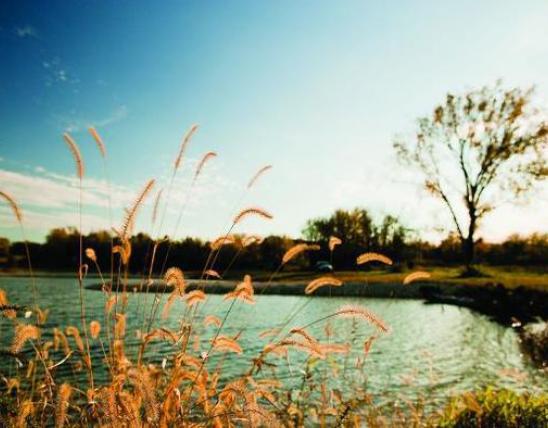










This area contains one of the best quality examples of lowland swamp and bottomland forest in Missouri.
Media

Scientific Name
Quercus phellos
Family
Fagaceae (oaks)
Description
Willow oak is a medium to large tree with a dense, pyramidal crown (becoming more rounded with age) and straight, clear trunk.
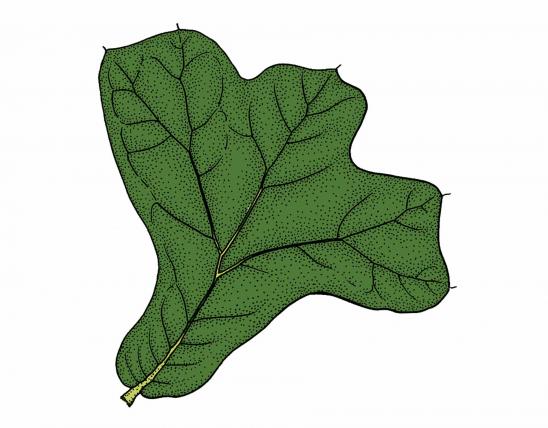
Leaves are alternate, simple, 2–5 inches long, to 1 inch wide, shaped like willow leaves, narrow, gradually tapering at both ends, thick; margin entire, bristle-tipped. Leaves turn pale yellow in fall.
Bark is smooth, light reddish-brown on young trees; dark gray with rough, irregular, scale-covered plates and shallow grooves when older.
Twigs are slender, reddish-brown and hairy; gray and smooth with age.
Flowers April–May, in catkins.
Fruits September–October, acorns solitary or in pairs; nut brown with dark stripes, rounded, about ½ inch long; cup covering about ¼ of the nut, saucer-shaped, shallow; scales small, flattened, greenish- to reddish-brown, finely hairy; seed bitter; ripen in autumn of the second year.
Similar species: Shingle oak (Q. imbricaria) has wider leaves and deeper acorn cups; it is also more widely distributed in Missouri. Willow oak is a type of oak and is not at all a willow; it was named for its willow-like leaves.
Size
Height: to 80 feet.
Where To Find

Restricted to southeast Missouri. The native range of this plant extends to the south and southeast of our state, and the Missouri Bootheel represents a northwestern extreme of its range.
Habitat and Conservation
Occurs in poorly drained soils, in wet bottomland forests bordering swamps and slow streams in the southeastern Missouri lowlands. May do well when planted as ornamental throughout Missouri. This species is uncommon in Missouri due to loss of habitat in the southeastern lowlands.
Status
Willow oak belongs to the red oak/black oak section of oak trees; its membership in that group can be seen in the bristle-tipped leaves and bitter acorns that mature in their second (not first) autumn. Because it takes two growing seasons for an acorn to mature, oaks in this group always have some tiny, immature acorns on their branches in wintertime.
Human Connections
A popular ornamental tree in the southern United States, known for its rapid growth, long life, and handsome shape. The lumber has many uses, and like most oaks, the bark was used medicinally, as an astringent tea, by Native Americans.
Ecosystem Connections
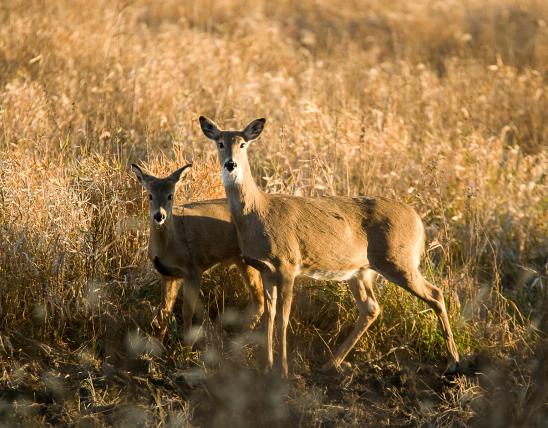
The acorns are eaten by songbirds, woodpeckers, ducks (especially mallard and wood duck), wild turkey, bobwhite, mice, squirrels, raccoon, and white-tailed deer. Missouri's southeastern lowland forests are a unique and interesting part of our state, and this species is a part of that habitat.
Title
Media Gallery
Image

Caption
Willow oak (Quercus phellos) leaf.
Credit
Paul Nelson
Right to Use
Use of this image is restricted to MDC only
Image

Caption
Willow oak leaves are narrow and taper at both ends; they look a lot like willow leaves.
Credit
Julianna Schroeder
Right to Use
Use of this image is restricted to MDC only
Image

Caption
The nuts of willow oak acorns are brown when mature, with dark stripes, and are rounded, about ½ inch long. The cup covers about ¼ of the nut.
Credit
Julianna Schroeder
Right to Use
Use of this image is restricted to MDC only
Image

Caption
Willow oak (Quercus phellos) acorn.
Credit
Paul Nelson
Right to Use
Use of this image is restricted to MDC only
Image

Credit
Jim Rathert
Right to Use
Photo by Jim Rathert, courtesy Missouri Department of Conservation
Image
Caption
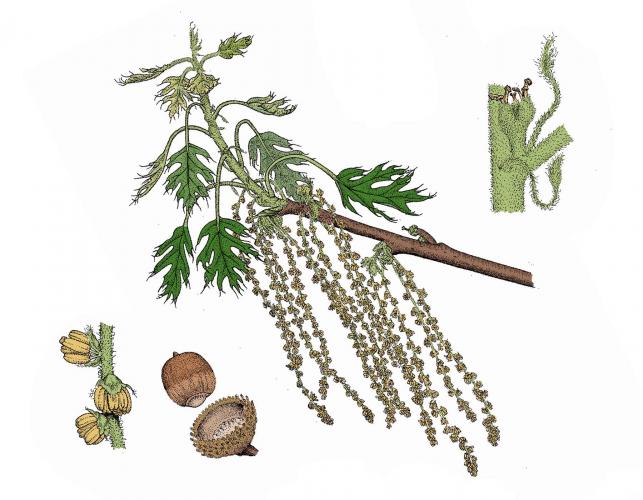
All oak flowers are similar in appearance and emerge in early spring as the new leaves are expanding. Male and female flowers appear on the same tree.
Credit
Paul Nelson
Right to Use
Use of this image is restricted to MDC only
Image

Image

Image

Image

Image

Image

Title
Similar Species
Similar Species
Where to See Species

Oak Ridge Conservation Area is in Stoddard County, immediately west of the city limits of Dudley. Old Highway 60 forms the northern boundary of and provides access to this 243-acre area.

This property was donated to the Department by the Farmers Home Administration (FmHA) in 1992. Until acquired by FmHA in 1988, most of the area was farmed in milo, wheat, and soybeans.
About Trees, Shrubs and Woody Vines in Missouri
There are no sharp dividing lines between trees, shrubs, and woody vines, or even between woody and nonwoody plants. “Wood” is a type of tissue made of cellulose and lignin that many plants develop as they mature — whether they are “woody” or not. Trees are woody plants over 13 feet tall with a single trunk. Shrubs are less than 13 feet tall, with multiple stems. Vines require support or else sprawl over the ground.