











White dogtooth violet, or white trout lily, is a small, early blooming lily that lives in wooded areas. Its flowers are white and its narrow leaves are purplish or brownish mottled. They are often found as a colony of blade-shaped, green-and-brown-mottled leaves poking out of the earth in spring, with only a few producing flowers.
Growth habit: The plants are perennial, growing from a bulblike corm. Most plants in a colony only produce a single, waxy-coated leaf, which usually is held erect and usually mottled with brown. (This plant is sometimes called “thousand-leaf” because, in large colonies, literally thousands of leaves cover the ground.)
The flowers are single at the tip of the single flowering stalk; white, sometimes tinged with pink, purple, blue, or green, often nodding at the ends of stems. The 6 tepals (3 petals plus 3 petal-like sepals) recurve (bend backward), as the flower ages. Flowering is restricted to plants that have 2 leaves.
Blooms March–May.
The leaves are to 6 inches long and 1½ inches wide, narrowly ovate or elliptic, mottled dull green and purplish brown, with a silvery/waxy (glaucous) coating on the underside.
The fruits are green, obovoid (reverse-egg-shaped) capsules, ½ to 1 inch long, with a blunt tip.
Similar species: Three other species of dogtooth violets, or trout lilies (Erythronium spp.), have been recorded for Missouri:
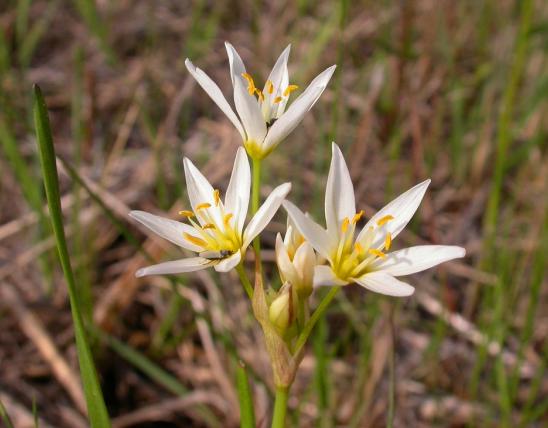
- The one most similar to white dogtooth violet is prairie dogtooth violet, or prairie trout lily (E. mesochoreum). It is scattered nearly statewide, though apparently absent from the Bootheel lowlands.
- It occurs in open areas: prairies, glades, and dry to rich forests, frequently in rocky, open sites (less commonly in wooded areas).
- Its tepals spread but do not recurve backward.
- Its leaves are narrower, lack the mottled coloration, tend to fold in half lengthwise, and typically arch so the leaf tips often touch the ground.
- Its populations have much larger percentages of blooming plants, so they do not form the big colonies of flowerless leaves sticking out of the ground.
- Our other two members of the genus both have yellow flowers, and both are commonly called yellow trout lily, yellow dogtooth violet, or yellow adder’s tongue. See Ecosystem Connections for more about these two species.
Stem length: 4–8 inches, flowering at the shorter length and reaching the longer length as the fruits mature.

Scattered nearly statewide.
Habitat and Conservation
Occurs in moist bottomland and upland forests of ravines and valleys, often in alluvial soils, less commonly on shaded lower ledges of bluffs.
In early spring, hikers often encounter this species in a big colony of nonflowering (young) plants, which amount to hundreds of single blade-shaped leaves poking out of the ground. The plants with only one leaf aren’t ready to flower yet, but the ones with two leaves are.
Status
Native Missouri spring-blooming wildflower; woodland wildflower.
Human Connections
The leaves and corms of various dogtooth violet species apparently have been cooked and eaten, but the corms have also been reported to have emetic properties (causing vomiting).
Because the flowers are so beautiful, dogtooth violets are often used in gardens. If you want to plant them, please don’t dig them from the wild. Instead, purchase plants from ethical nurseries. It takes at least four years to raise a flowering plant from seed. Ethical native wildflower nurseries propagate dogtooth violets primarily by vegetative reproduction of cultivated plants.
This plant looks absolutely nothing like a violet, and for good reason: It isn’t one! A member of the lily family, it is more closely related to tulips and daffodils. The alternate common names “white trout lily” and “white fawn lily” both reference the mottled leaves and put the plant in the correct family.
The term “dogtooth” apparently refers to the pale, conical underground corms, which supposedly resemble the canine teeth of dogs.
The genus name, Erythronium, is from the Greek root erythro-, meaning “red”; it originally applied to a European relative that had reddish flowers. That European species, by the way, is E. dens-canis, whose species name means “dog-tooth,” in reference to the elongated shape of the whitish corms.
The species name, albidum, means “white,” for the flower color.
Ecosystem Connections
A variety of bees, including honeybees, mason bees, cuckoo bees, digger bees, plasterer bees, halictids (sweat bees), and andrenids (mining bees) visit the flowers. One species, the trout-lily andrena, or Easter bee (Andrena erythronii), is an early spring miner bee notable for favoring the members in this genus. Flies, butterflies, and skippers also visit the flowers for nectar, pollen, or both.
Dogtooth violets are one of several groups of spring wildflowers whose seeds have white, oily appendages called elaiosomes and are distributed by ants:
- The ants collect and carry the seeds to their nests, eat away the nutritious portion of the seeds, then discard the still-viable portion of the seeds to the “garbage” chamber of their nests.
- The ant nest's "garbage" chamber is a perfect, protected place for the young plants to sprout and thrive.
- Violets and Dutchman’s breeches are some other plants with elaiosomes.
Like other early spring wildflowers that bloom in woodlands, white dogtooth violet must accomplish its mission before it is shaded out by the canopy of trees above, or is covered by taller vegetation growing up around it.
Missouri has two species of yellow-blooming dogtooth violets; both are commonly called yellow trout lily, yellow dogtooth violet, or yellow adder’s tongue, and both are very similar:
- Our two yellow-flowered species are E. americanum, which is scattered in wooded habitats, mostly in the southeast part of the state (Ozarks and Ozark border regions), and E. rostratum, which is scattered in similar habitats, mostly in the southwest part of the state (Ozarks and in the unglaciated plains of southwest Missouri).
- E. rostratum’s fruits taper to form a pointy beak at the outer tip, whereas those of E. americanum are broadly rounded or straight across at the tip.
- E. rostratum’s tepals have a pair of tiny indentations at the base, which wrap around the adjacent stamen, whereas those of E. americanum do not have tepal bases that wrap around the stamen.
- E. rostratum’s tepals spread but usually don't reflex backward, whereas those of E. americanum often reflex.
Globally, there are approximately 25–30 species of in genus Erythronium. They occur in North America, Europe, and Asia. There are several to look for in the U.S. northwest, if you're there in spring:
- The northwestern United States has several lovely members of this genus, including yellow avalanche lily, or glacier lily (E. grandiflorum), white avalanche, lily or alpine fawn lily (E. montanum), coast fawn lily, or mahogany fawn lily (E. revolutum), Oregon trout lily, or giant white fawn lily (E. oregonum), and California fawn lily (E. californicum).