






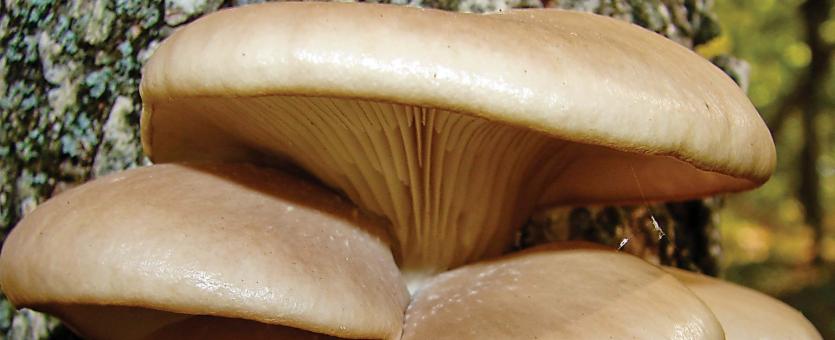
Gilled, in shelflike clusters; broad, fleshy, whitish, grayish, or tan cap; stubby, off-center stalk. Grows on stumps, logs, and trunks of deciduous trees. Year-round. Cap shell-shaped, semicircular to elongated; margin is smooth, sometimes wavy; whitish to grayish to tan; texture velvety; flesh is thick, white. Gills narrow; spacing nearly distant; white, becoming yellowish; attachment descending the stalk. Stalk (if present) short, thick; white; base is hairy; off-center, solid. Spore print white to grayish-lilac. Spores magnified are narrowly elliptical, smooth, colorless.
There are no lookalikes in Missouri that are poisonous.

Habitat and Conservation
Status
Life Cycle
Human Connections
This prized culinary mushroom has many proven health benefits.
It is also being explored as a "digester" of inorganic waste and as an environmentally responsible substitute for Styrofoam. The mycelium is grown in molds filled with waste grain, then heat-treated to stop growth when the mold is full.
People have found they can grow these choice edible mushrooms on coffee grounds and spent grain from beermaking.
Ecosystem Connections
This is one of the many fungus species that live on decaying wood. It and other such saprobic fungi play an incredibly important role in breaking down the tough materials wood is made of and returning those nutrients to the soil.
An orange-and-black pleasing fungus beetle, Triplax thoracica, is often found on oyster mushrooms.

Mushrooms are a lot like plants, but they lack chlorophyll and have to take nutrients from other materials. Mushrooms are neither plants nor animals. They are in a different kingdom — the fungi. Fungi include the familiar mushroom-forming species, plus the yeasts, molds, smuts, and rusts.
Always be cautious when eating edible mushrooms. Be absolutely sure of the ID, and only eat a small amount the first time you try it to avoid a reaction..