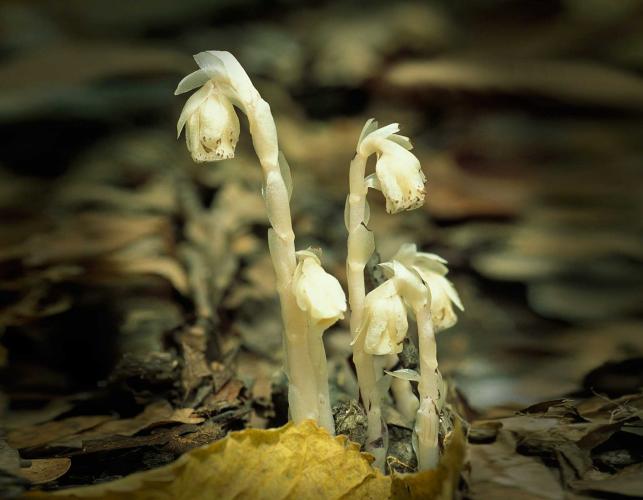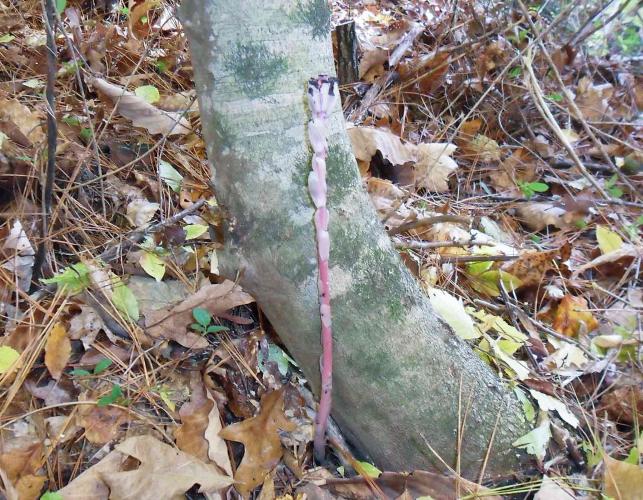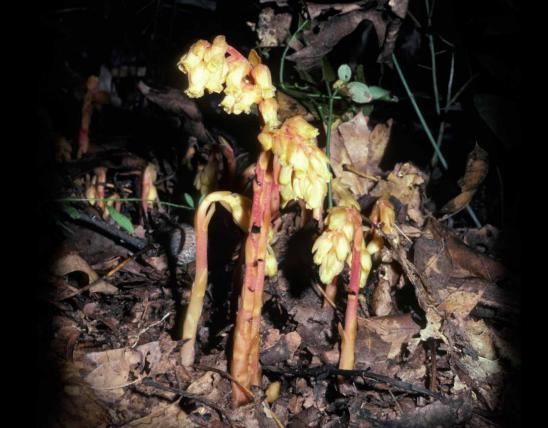












Ghost pipe, or Indian pipe, is a perennial wildflower that lacks chlorophyll and is therefore white (sometimes pinkish). It is sometimes misidentified as a mushroom. It usually grows in small clusters. Below ground, its roots join with fungi that connect to tree roots. This plant, then, takes nourishment indirectly from the trees.
The flowers arise singly on a white, scaly stem and are urn-shaped, nodding, with 4 or 5 petals and no sepals. The flowers are white, turning purple and later black. As the seeds ripen, the downturned flower gradually turns upright.
Blooms August–October.
Leaves are absent; they are replaced by scales on the floral stem.
Similar species: Ghost pipe is distinguished from pinesap (Monotropa hypopitys) by its only bearing one flower per stalk. Pinesap usually has up to 10 flowers on each stalk. Ghost pipe's species name, uniflora, means “one-flowered.”
Height: to 8 inches.

Scattered nearly statewide but nowhere common.
Habitat and Conservation
Occurs in humus-rich bottomland forests and moist to dry upland woods, mainly in oak-hickory woodlands.
Unlike most plants, ghost pipe lacks chlorophyll, so it is white, not green. Below ground, its roots join with fungi that join with tree roots. This plant thus takes moisture and nourishment indirectly from the trees, and also through the fungi's digestion of decaying substances in the soil. Because it lacks chlorophyll, ghost pipe can survive in quite shaded areas of forests.
Because of its complicated method of obtaining nourishment and need for appropriate types of fungi, this flower rarely survives transplanting, so take pictures, not plants, from the wild.
Status
Native Missouri perennial wildflower.
Human Connections
Organisms like ghost pipe — also called Indian pipe, ghost plant, and corpse plant — strike us as bizarre and cause us to halt, kneel, and take a closer look. They fill us with wonder and pique our curiosity. They train us to keep looking for wonderful things.
The common name "Indian pipe" has been growing out of favor in part due to the fact that the traditional ceremonial pipes of Native Americans do not much resemble the nodding flowers of this plant. With the long stem, whitish color, and deeply bent, urn-shaped "bowls," these flowers look more like vintage European-style clay tobacco pipes.
The genus name, Monotropa, means "one turn," and it refers to the one big downward bend that each plant makes near the top of the stalk. The species name, uniflora, or "one-flowered," distinguishes this species from pinesap, which typically has up to about 10 flowers per stalk.
Plants in genus Monotropa have been used for a variety of medicinal uses.
Ecosystem Connections
The fungi associated with ghost pipe are in the family Russulaceae, a group that includes the emetic russula, green cracking russula, indigo milky, and peppery milky. Like many other fungi, these mushrooms join with tree roots, and both tree and fungus benefit: The fungus gets food from the tree while expanding the tree's absorption network.
Ghost pipe and its relatives have been called saprophytic, mycotrophic, and epiparasitic. The designations change as people have come to understand the complex pathways that these plants use to get nutrients and moisture.
Bumblebees pollinate ghost pipe, obtaining nectar and pollen as rewards. The fertilized ovaries of ghost pipe mature into egg-shaped capsules about ½ inch long that contain numerous small seeds.
Taxonomy: Ghost pipe and its close relatives have sometimes been placed in their own family (the Monotropaceae), but DNA studies have shown they belong in the heath family, the Ericaceae (air-uh-KAY-cee-ee).
Family Ericaceae is the heath and blueberry family. Many of its members are shrubs or small trees, sometimes evergreen. In addition to heaths, heathers, and blueberries, the family also includes cranberry, lingonberry, huckleberry, rhododendrons, and azaleas.
More relatives: Maybe it's obvious, but the heath family includes the species that dominate the heathlands of Britain and other European countries (think of the sweeping landscapes depicted in Wuthering Heights, King Lear, and Ethan Frome). Many beautiful small shrubs are in this family; they typically have nodding, urn-shaped flowers.
There are a lot of lovely heath family species in western North America. When you travel west, look for examples of dwarf shrubs with these urn-shaped, nodding flowers, especially in mountain habitats.