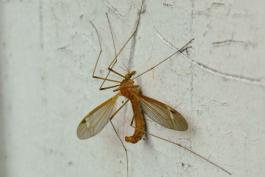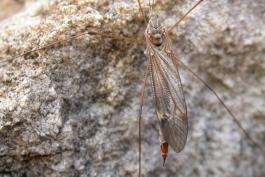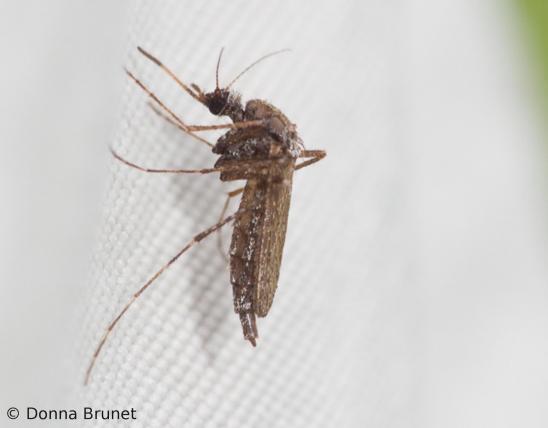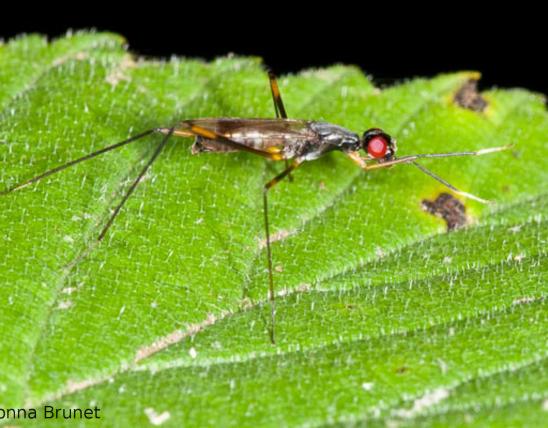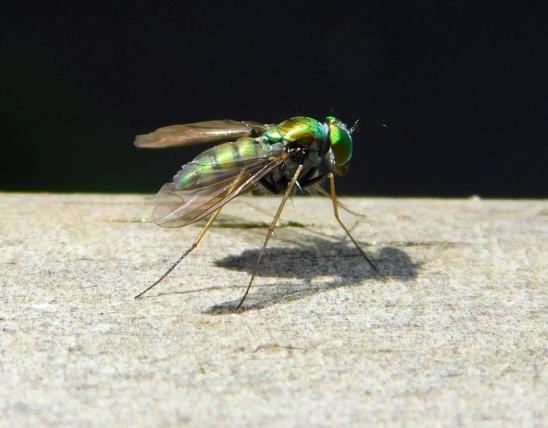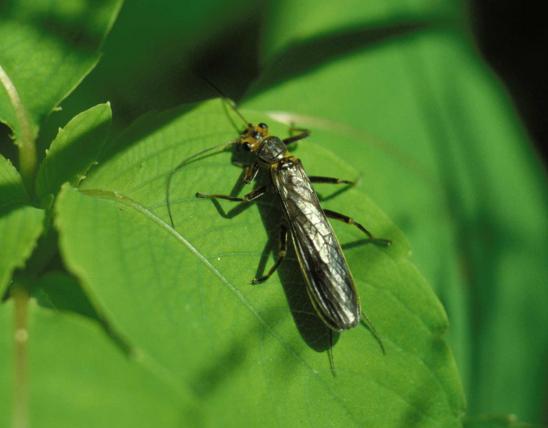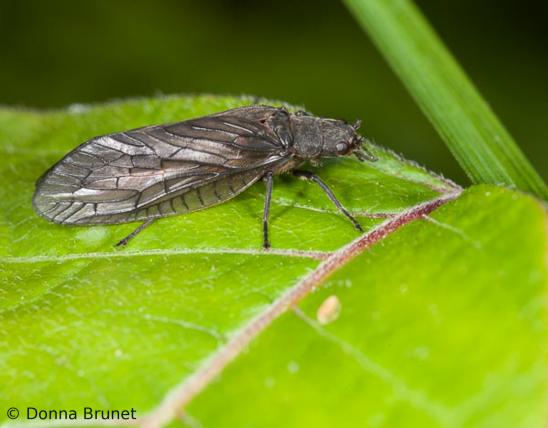










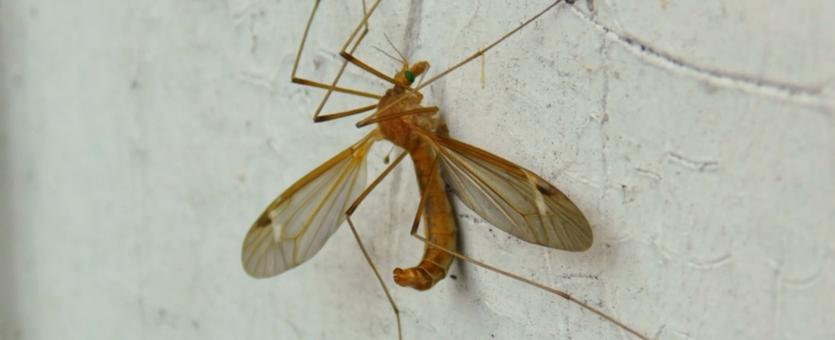
There are hundreds of species of crane flies in North America, but nearly all look like giant mosquitoes. They have slender bodies, very long legs, and one pair of wings that are often held out at a 45-degree angle to the body. Just behind the wings, attached to the body, are two small, antennae-like appendages called halteres. These function like gyroscopes during the crane fly’s weak and wavering flights. The mouthparts look like a snout.
Female crane flies have thicker abdomens, which have a pointed (and harmless) tip for egg-depositing. Males have pincerlike claspers at the tip of the abdomen.
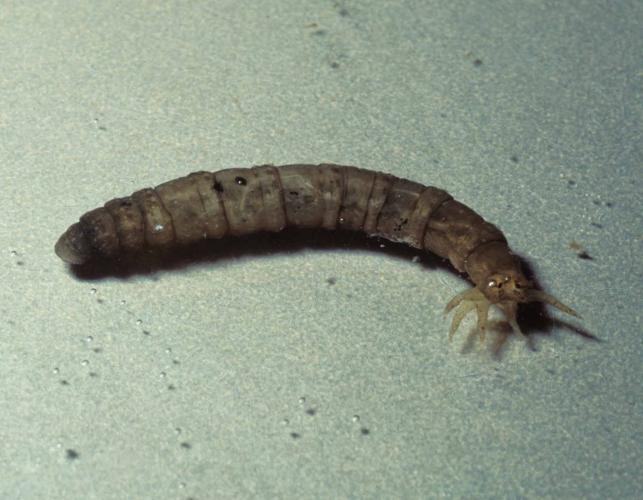
Crane fly larvae are essentially tan or gray grubs: segmented caterpillars with a definite head and with tiny, fleshy projections at the hind end.
Key identifiers of adults:
- Resemble giant mosquitoes:
- slender bodies
- very long legs
- one pair of wings, often held at 45-degree angle to body
- length can be to 1½ inches
- Weak, wavering flight
- Mouthparts like a snout (not a piercing, tubelike mouth)
- No scales on wing veins
Similar species: Adult crane flies can be distinguished from mosquitoes by their lack of a piercing, tubelike mouth, lack of scales on the wing veins, and a V-shaped groove on the thorax (the body part behind the head, from which the wings emerge).
A fascinating group of insects called hangingflies (family Bittacidae) look a lot like crane flies, but they have four (not two) wings and they lack halteres. They hang from a perch from their forelegs and capture prey with their long, dangling hind legs and large feet. Hangingflies are in order Mecoptera and thus are related to scorpionflies. (They are not "true flies," order Diptera, at all.)
Adult length: to about 1½ inches (varies by species).
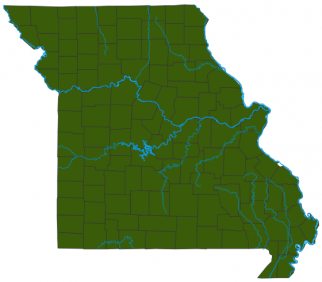
Statewide.
Habitat and Conservation
Because they can fly, the adults can be found nearly anywhere. Most often they occur in moist woods and fields, and near streams and ponds. Different species can be found during spring, summer, and fall.
The larvae are usually aquatic, living in streams and lakes, but also in moist places such as under leaf litter in ditches and sometimes underground.
Food
The many different kinds of crane flies have different lifestyles. The species that have aquatic larvae often eat decaying vegetation and leaf debris. Some species eat other insects, including mosquito larvae. Other species have terrestrial (land-dwelling) larvae that eat roots, and some of these can be lawn pests.
As adults, many crane flies do not eat at all, and only focus on mating. Those adults that do eat tend to drink nectar from flowers.
Life Cycle
Like mayflies, the winged adult crane flies usually do not eat, and spend their brief time mating and laying eggs. Females lay their eggs either under water or in soil near water. The larvae develop under water, pupate, then emerge as adults. Most crane flies have only one brood a year.
Human Connections
Crane flies do not bite and are completely harmless.
The larvae of some species can be lawn pests.
The aquatic larvae of most other species are sensitive to pollution and a decline in their numbers can indicate (for example) that pesticide runoff from lawn treatments is present and harming stream life.
An old-time Ozark name for a crane fly was "gallynipper." The word was also used for several other types of flying insects, too.
Ecosystem Connections
Like many insects that spend their immature stages feeding and growing under water, crane flies grow up, take flight, return to the terrestrial places and become food for land creatures. Thus the crane fly returns aquatic nutrients back “upstream” to the land.