












Two chickadee species live in our state, and they can be hard to tell apart. In both, the adults have gray upperparts, with a black cap and white cheeks. The underparts are white, the sides buffy, and the throat and upper breast are black.
The black-capped chickadee (Poecile atricapillus) is generally found in northern Missouri, though some may move southward during winter.
- It has wing coverts and some secondaries edged in white. (This is visible from midwinter to spring; by summer, the white edges of these feathers have worn off.)
- The lower edge of the black bib may appear ragged, and the sides and flanks of winter adults are more buffy than in Carolina chickadee.
- The song is a 2- or 3-syllable phrase with the first note slightly higher than the second: “fee-bee” or “fee-bee-bee.” The call is a slow “chick-a-dee-dee-dee.”
The Carolina chickadee (Poecile carolinensis) is generally found in southern Missouri. It does not appear to move northward.
- It has the wing coverts gray, not edged in white.
- The lower edge of the black bib is more sharply defined than in the black-capped chickadee, and the sides and flanks of winter adults are gray and much less buffy, as well.
- The song is a 4-note phrase with the first and third notes higher than the second and fourth: “fee-bee fee-bay.” The “chick-a-dee-dee-dee” call is noticeably faster than the black-capped’s.
The best time to observe the subtle differences in plumage is after the fall molt. By spring, the feathers may be worn down and less distinct.
There is a fairly clear line where the ranges of the two species meet: it runs westward from St. Louis to Jefferson City and Clinton, and southwest toward Prairie State Park, passing just east of Nevada. This 10-mile "contact zone" is where the Great Plains meet the Ozark Plateau. Where the ranges overlap, the birds sometimes hybridize and sing intermediate songs, making identification difficult. If you live in the contact zone, it can be impossible to identify the species.
Length: 5¼ inches (black-capped); 4¾ inches (Carolina).

Black-capped: generally found in northern Missouri, occasionally moving southward in winter. Carolina: generally found in southern Missouri, seldom wandering north of their range.
Habitat and Conservation
Common permanent residents in forests, woodlands, forest edges, parks, and most areas with trees with decaying sections where nesting cavities can be excavated.
Chickadees are a common and distinctive backyard birds.
Food
Chickadees forage for insects, spiders, seeds, acorns, and berries. They are commonly seen at birdfeeders and suet.
The famous conservationist Aldo Leopold noticed that the chickadees in his forest “investigate every loud noise.” He explained that for chickadees, nature’s “dinner bell” was the crash of falling old trees full of thousands of insect eggs and pupae to be eaten.
Status
Common permanent resident.
Life Cycle
There is one brood a year. Nest cavities are about 8 inches deep and are excavated by both the male and female in rotting trees. Chickadees may also nest in bird boxes or old woodpecker cavities. The female builds the cup-shaped nest, lined with soft animal hair and plant fibers, on a foundation of coarser materials. Eggs are incubated for usually less than two weeks before hatching, and in another two weeks the young are fledged. In winter, chickadees travel in flocks with other species.
Human Connections
Tiny, perky chickadees, with their bright voices and dapper black-and-white heads, delight humans with their energetic presence at backyard feeders — even on the coldest of winter days. Aldo Leopold said of the chickadee: “Everyone laughs at so small a bundle of large enthusiasms.”
Ecosystem Connections
Chickadees commonly join with titmice, nuthatches, and woodpeckers in winter foraging flocks. They use their tweezerlike bills to pick insect and spider eggs and pupae from crevices in tree bark.
Chickadees and their eggs and young are preyed upon by other predators, including snakes, cats, blue jays, accipiter hawks, and more.


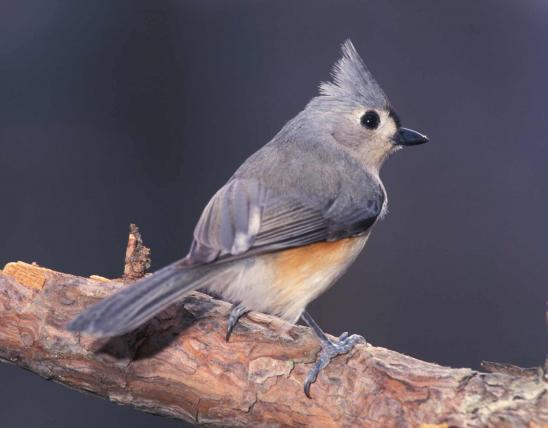

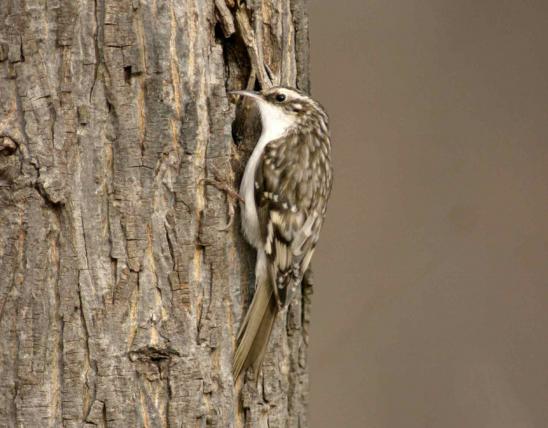


About 350 species of birds are likely to be seen in Missouri, though nearly 400 have been recorded within our borders. Most people know a bird when they see one — it has feathers, wings, and a bill. Birds are warm-blooded, and most species can fly. Many migrate hundreds or thousands of miles. Birds lay hard-shelled eggs (often in a nest), and the parents care for the young. Many communicate with songs and calls.