


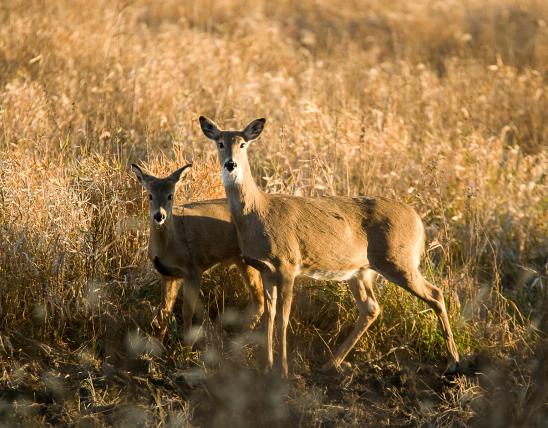







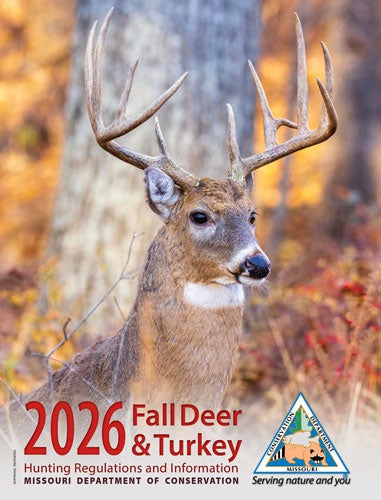

Chronic Wasting Disease (CWD) is a contagious, deadly brain disease of white-tailed deer and other members of the deer family, called cervids. The disease is caused by a misfolded protein and can be spread by direct contact between deer, when deer encounter the carcass of an infected deer, or when deer encounter the misfolded proteins shed in the environment (urine, feces, saliva) by an infected deer.
What we know. What we’re still learning. And how we’re protecting Missouri’s deer and hunting traditions — together.


- CWD is a 100% fatal disease that spreads through deer-to-deer contact and poses a significant threat to Missouri’s deer herd and the future of deer hunting in Missouri.
- CWD cannot currently be cured or vaccinated against.
- Once CWD becomes well established, management actions to sustain a healthy herd become more difficult. Keeping infection rates below 5 percent is our greatest opportunity to slow the disease.
- When enough deer have CWD, it can cause significant population declines with fewer older bucks in the herd. With infection rates below 5 percent in most areas, we have a window of opportunity, but it will not stay open forever and may already be closing in some areas.
- Removal of the CWD Management Zone. Most Missouri counties either have had a case of CWD or are within 10 miles of a confirmed case of the disease, so a designated CWD Management Zone is no longer needed. Removing the CWD Management Zone also helps simplify regulations for hunters.
- Placement of feed and minerals for deer will continue to be prohibited in counties within 10 miles of where CWD has been detected. Placing feed and minerals for deer artificially congregates them, resulting in an increased risk of disease transmission. It has been prohibited in counties close to where CWD has been detected since CWD was first found in Missouri. Grain, salt products, minerals, and other consumable products used to attract deer will continue to be prohibited in counties within 10 miles of where CWD has been found, which, this year, now includes Benton, Johnson, and Pettis counties.
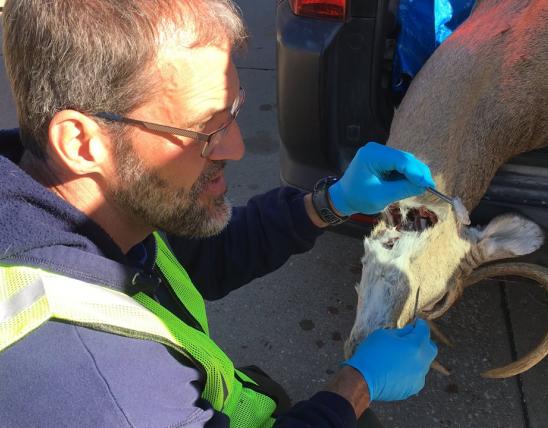
- Moved mandatory CWD sampling during the opening weekend of the November Portion of firearms deer season to a four-year county rotation. Mandatory CWD sampling will now be conducted in every county of the state once every four years. Hunters who harvest a deer in designated counties during Nov. 14–15 must take their deer, or the head, on the day of harvest to one of MDC’s mandatory CWD sampling stations.
- Removal of the CWD portion of the firearms deer season. Removing the CWD Portion will simplify the structure of deer season for hunters and not significantly affect deer harvest.
- Removal of the CWD Management Zone. Placement of feed and minerals for deer will continue to be prohibited in counties within 10 miles of a CWD-positive detection.
- Removal of the Antler Point Restrictions (APR). MDC has removed the antler-point restriction (APR) for the final 18 counties where it was most recently in place. Yearling bucks, which the APR protects, travel many miles and can spread CWD long distances. Removing the APR will help to minimize the spread of CWD while also simplifying regulations.
- Increase the minimum acreage requirement to receive CWD Management Permits from 5 acres to 20 acres. Landowners are now required to have at least 20 contiguous acres in a CWD core area to receive CWD Management Permits. The change will make the acreage requirement consistent with other no-cost landowner deer hunting permits, reducing potential confusion for landowners. MDC has also simplified the application process.
- Post-Season Removals. As a result of public engagement and continued evaluation, MDC will not conduct targeted deer removals after the season and currently has no plans to resume the activity. Instead, MDC staff will work with hunters, landowners, and other partners to develop a localized approach in which hunter harvest is the primary tool to manage deer numbers and CWD during the regular deer season.
The goal of CWD management is to protect the deer herd. Our mission is to keep Missouri’s deer herd healthy, and we need your help to do it.

CWD threatens the long-term health of Missouri's deer herd.
- We want to preserve hunting for future generations.
- We want to help maintain venison as a food source for Missourians.
- We want to work with Missourians to protect this valuable natural resource.
For additional information about CWD, visit the National Deer Association, the USDA, the U.S. Geological Survey, the Chronic Wasting Disease Alliance, and the Boone and Crockett Club.

Title
Does CWD affect deer hunting?

Title
Is CWD management about money?
No. MDC spends money from its budget and is reimbursed for 75 percent of qualifying expenses related to CWD testing and management through the U.S. Fish and Wildlife Service’s Wildlife Restoration Program. The funding is not affected by the number of CWD cases found, and MDC does not make a profit from CWD management. MDC receives no additional federal funding for CWD-related activities.
During Fiscal Year 2025, from July 2024 to June 2025, MDC spent $6,281,231 on CWD testing and management and was reimbursed for $4,710,923 (75 percent of total cost) through the Wildlife Restoration Program. MDC was not reimbursed for $1,570,308 (25 percent of total cost). These funds were spent to ensure Missouri’s deer herd remains healthy and to protect the $1.6 billion that deer hunting contributes to Missouri’s economy each year.

Title
Has CWD always been in Missouri?
CWD has not always been present in Missouri. MDC tested more than 30,000 deer over a 10-year period before detecting the disease, indicating it was relatively new.

Title
Why not just let nature take its course?
CWD threatens the long-term health of Missouri’s deer herd. MDC is working to preserve the herd and protect Missouri's hunting culture, traditions, and economy.
If we let nature take its course, we would have a heavily infected herd and would reach the CWD tipping point.
Tipping point: Missouri’s statewide CWD rate remains under 1 percent, but some local areas are already approaching 5 percent. When infection rates reach 5 percent, spread accelerates and management becomes far less effective. Experience in other states suggests that once this threshold is reached, options to slow the disease are greatly diminished.
Title
What’s the difference between EHD (blue tongue) and CWD?
| EHD Epizootic Hemorrhagic Disease (Bluetongue) | CWD Chronic Wasting Disease | |
|---|---|---|
| Virus that spread by biting gnats in late summer. Symptoms include fever and internal hemorrhaging. | OVERVIEW | Disease of the central nervous system in which the brain deteriorates. |
| Doesn’t spread deer to deer, only through bites from infected insects. | TRANSMISSION | Does spread deer to deer through direct contact, bodily fluids, body parts of infected deer or infectious materials in soil. |
| Bucks and does of all ages are equally susceptible to being bitten by infected insects. | OCCURRENCE | Higher infection rates among mature bucks, likely because they cover more ground and frequently contact toher deer. |
| Viruses are found across North America, with outbreaks typically occurring in late summer, during droughts and extreme heat | LOCATION | Present in most states and several Canadian provinces. Preventing spread of CWD is critical, as transporting infected deer can spread disease long distances. |
| Some deer survive infection. Herd immunity is higher in areas with longer historical exposure. | MORTALITY RATE | Always fatal! Infected deer become more vulnerable to predictors, cars, and other illnesses, but those that live long enough die from CWD’s effects. |
| For deer that die of the virus, death usually occurs within a few days. | SPEED OF DEATH | Incubates in infected deer for 1-2 years before symptoms appear, during which deer can spread CWD to other deer. |
| Viruses cannot survive outside the body of the insect vectors or the deer hosts. | DURABILITY | Infectious prions are shed in feces, urine, saliva, blood, and from carcasses of infected animals and remain viable in the environment for years. |
| Cannot infect people, either through insect bites or through handling or consuming infected deer. | HUMAN HEALTH | No evidence that CWD is a health issue in humans, but the CDC advises hunters in CWD zones to test harvested deer and wait for result before eating the venison. |
| Outbreaks vary locally from mild to serious, but deer populations rebound. | LONG-TERM | Except where active management keeps infection rates low, CWD threatens to cause significant declines in deer populations. |
Title
What happened to the deer removed during targeted removal?

Title
Did targeted removal limit my opportunity to harvest a deer?


Title
Can humans get CWD from eating an infected deer?
CWD has not been shown to infect people. However, the CDC recommends that hunters test deer for CWD if hunting in an area where the disease has been found and avoid consuming meat from any deer that appears sick or tests positive for CWD.
MDC's goal is to find the disease as early as possible where it exists and to limit its impacts on Missouri's deer herd and hunting culture. Control efforts have included changes to hunting regulations, providing landowners with additional hunting permits where CWD has been found, and using targeted removal in localized areas. These efforts have helped keep CWD at low levels. There are far fewer infected deer in Missouri today because of MDC's CWD management efforts.
As a result of public engagement and continued evaluation, MDC will not conduct targeted deer removals after the season and currently has no plans to resume the activity. Instead, MDC staff will work with hunters, landowners, and other partners to develop a localized approach in which hunter harvest is the primary tool to manage deer numbers and CWD during the regular deer season.
If CWD is not managed, the disease will spread more quickly and more deer will become infected. CWD is already negatively impacting deer herds and deer hunting in other states.
Watch the following testimonial video from Wisconsin to see the impact unmanaged CWD can have on an area.

Hunters are Missouri’s first line of defense against CWD.
Hunt more. Consider harvesting an additional deer if you hunt in an area that has CWD. Surplus venison can be donated through the Share the Harvest program.
Follow regulations. Learn the Missouri deer regulations, including CWD regulations.
Get your deer tested. Hunters can get free CWD testing at Voluntary Sampling Sites throughout the entire deer hunting season or during opening firearms weekend at Mandatory Sampling Sites.
Report sick deer. Reporting sick deer helps protect the health of wildlife in Missouri.
Stay informed. Use the CWD Interactive Hub to find mandatory and voluntary sampling sites as well as sampling results.
To keep up with what's happening in conservation in Missouri, sign up to receive MDC email updates.
Latest findings
- CWD Interactive Hub — Includes mandatory and voluntary sampling sites as well as sampling results.
- Links to CWD research studies — Find results of in-depth CWD studies from across the country.
Recent management changes
As a result of public engagement and continued evaluation, MDC will not conduct targeted deer removals after the season and currently has no plans to resume the activity. Instead, MDC staff will work with hunters, landowners, and other partners to develop a localized approach in which hunter harvest is the primary tool to manage deer numbers and CWD during the regular deer season.
There are several regulation changes for the 2026 deer season.
- For the 2026/2027 season, changes include:
- Removal of the CWD portion of the firearms deer season.
- Removal of CWD Management Zone. Placement of feed and minerals for deer will continue to be prohibited in counties within 10 miles of where CWD has been detected.
- Moved mandatory CWD sampling during the opening weekend of the November Portion of firearms deer season to a four-year county rotation. Mandatory CWD sampling will now be conducted in every county of the state once every four years.
- Removal of Antler Point Restriction (APR) in the 18 counties where it was most recently in place.statewide.
- Increase in CWD Management Permit acreage requirement to 20 acres.
MDC's next steps
- Continue to engage with hunters, landowners, and other Missourians to ensure Missouri's deer herd remains healthy.
- Conduct research to help guide future CWD management efforts.
- Follow the recently revised 10-year deer management plan, Missouri White-Tailed Deer Management Plan (2025-2034).
Addressing it takes research, management, communication, and partnerships.
MDC has been committed to working with the public since our inception in 1937. We have been working with hunters and landowners on CWD for more than two decades, and we continue to listen to public input. This timeline highlights some of our CWD-related actions over the past 25 years.
2002-2010
In the November issue of the Missouri Conservationist, MDC informed the public about CWD in nearby states and announced the beginning of CWD surveillance in Missouri.
From 2002 to 2004, 6,000 deer were tested.
Nearly 33,000 deer were tested prior to the first case of CWD detected in Missouri.
2010-2011
CWD was detected in confined deer facilities in Linn and Macon counties.
2012
CWD confirmed in two free-ranging bucks in Macon County.
Early in the year: In response to the two positive free-ranging deer, MDC again worked with landowners and the public in Linn and Macon counties to sample 657 additional free-ranging deer to estimate the prevalence and distribution of the disease in the local area. From this sampling, two adult does and one adult buck tested positive for CWD.
Late in the year: MDC designated the CWD Containment Zone (Adair, Chariton, Linn, Macon, Randolph and Sullivan counties), which included the CWD Core Area (a 30 square-mile area surrounding the positive confined deer facility and CWD-positive free-ranging deer in Macon County).
2015
MDC tested 7,756 free-ranging deer for CWD. Results yielded seven additional confirmed positives for the fatal deer disease, including two new counties: Cole and Franklin.
2016
MDC holds its first mandatory sampling weekend during firearms deer season.
2018
MDC held six open houses across the state for public feedback on potential carcass movement restrictions.
2021
Testing detected 86 new cases of CWD.
MDC added Camden, Laclede, McDonald, and Pulaski counties to the CWD Management Zone when CWD was found in or near them.
2022
Testing detected 117 new cases.
MDC held public meetings in Jefferson, Perry, and Ste. Genevieve counties to update hunters and landowners on MDC's management of CWD.
2023
Testing detected 162 new cases of CWD.
Seven counties in northwest Missouri were added to the CWD Management Zone when deer that tested positive for CWD were found in or near these counties: Caldwell, Carroll, Clay, Clinton, Grundy, Livingston, and Ray.
2024
Testing detected 243 new cases of CWD.
MDC and the National Deer Association (NDA) continue to host webinars for landowners interested in managing deer on their properties.
MDC hosted meetings to update landowners on MDC's management of CWD in their areas and to provide information on how to partner with MDC by registering for management permits.
2025
MDC held 10 deer management open houses across the state and invited hunters to talk with MDC staff about deer management and CWD.
December: MDC paused post-season targeted removal efforts indefinitely to work with hunters and landowners to adapt and identify a more sustainable path forward to ensure Missouri's deer herd remains healthy.
2026
MDC held 8 deer management community conversations across the state to talk with hunters, landowners, and other interested Missourians about deer management and CWD.
As a result of public engagement and continued evaluation, MDC will not conduct targeted deer removals after the season and currently has no plans to resume the activity. Instead, MDC staff will work with hunters, landowners, and other partners to develop a localized approach in which hunter harvest is the primary tool to manage deer numbers and CWD during the regular deer season.